
What if your body gave you a 48-hour warning before your next 3 AM wake-up call? For the 1.3 billion women globally navigating menopause by 2025, the standard perimenopause symptom checker has always functioned like a rearview mirror. You log the night sweat after it happens. You record the mood shift once the damage is done. It's a cycle of passive endurance. By 2026, the shift from manual logging to AI-driven foresight will fundamentally redefine how you experience your biological transition.
You're likely exhausted by the unpredictability of sudden heat or uncharacteristic irritability. It's frustrating to feel unheard by traditional clinical models that only look at where you've been. You deserve more than a static checklist; you deserve a roadmap. This guide reveals how to move beyond basic tracking to anticipate hormonal fluctuations before they disrupt your life. We'll explore the leap from reactive data to proactive, actionable wellness plans that finally put you back in control of your daily rhythm.
Key Takeaways
- Understand why the perimenopause transition is non-linear and how to navigate this 10-year journey with total clarity.
- Identify the 34+ physical and cognitive symptoms, including "unspoken" changes like itchy ears, that often go unnoticed.
- Stop reacting to discomfort and start anticipating it by evolving beyond the traditional perimenopause symptom checker into an AI-driven early warning system.
- Integrate wearable data with quick subjective logs to build a personalized dashboard that predicts your energy and mood shifts.
- Shift from passive endurance to informed control by discovering how your unique biological fingerprint can signal disruptions before they occur.
Understanding the Perimenopause Transition: Why Symptoms Are Moving Targets
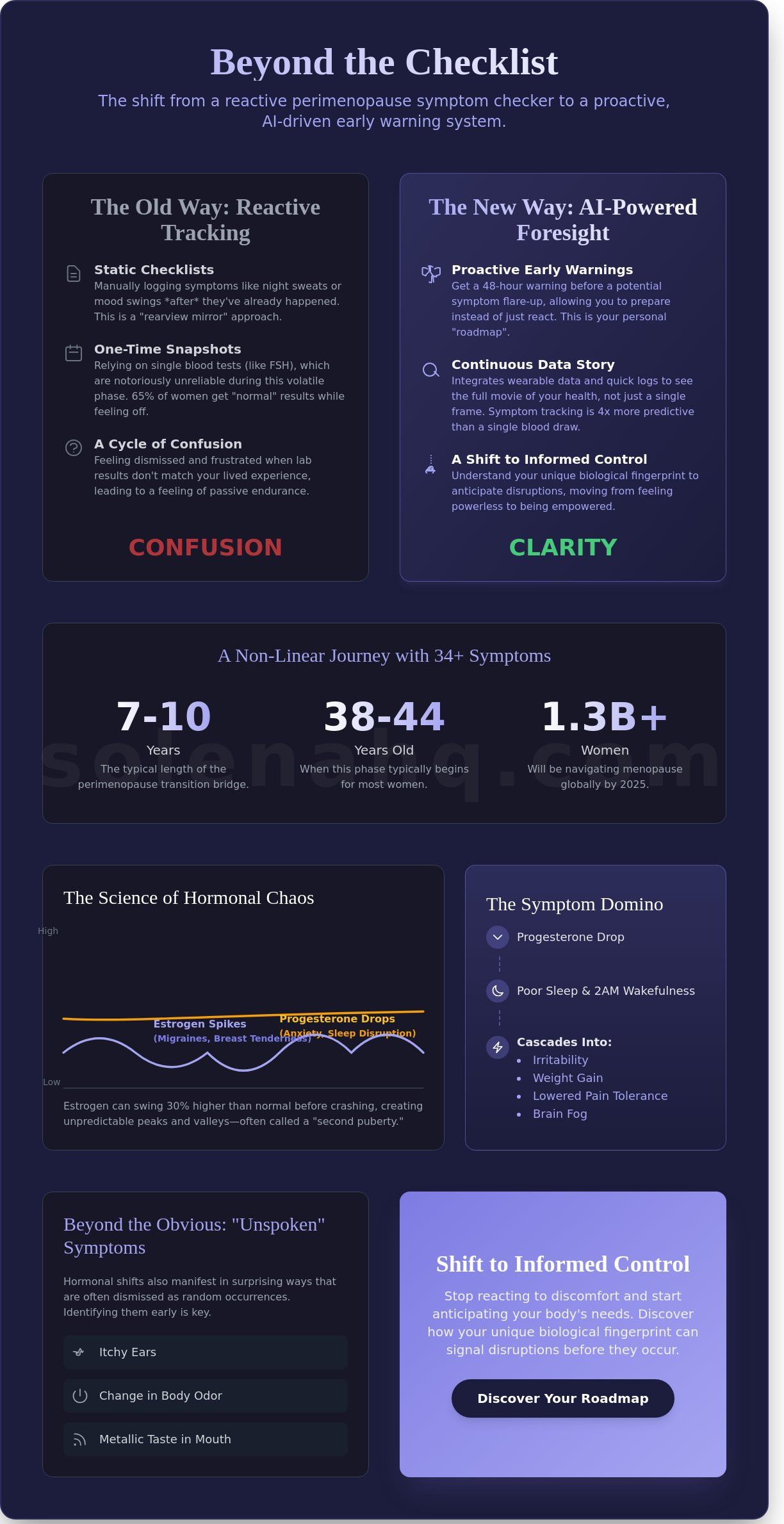
Perimenopause is a 7 to 10 year journey. It marks the long bridge to the menopause transition. It isn't a linear decline. It is a series of unpredictable peaks and valleys. For most women, this phase begins between age 38 and 44. It changes how you sleep, think, and feel. A traditional perimenopause symptom checker often fails because it treats symptoms as static events. They aren't static. They are moving targets. You aren't just "getting older." Your body is undergoing a fundamental neuroendocrine shift. Understanding this distinction is the first step toward regaining control.
To better understand how these hormonal shifts impact your daily life, watch this expert breakdown:
The Science of Hormonal Chaos
Scientists often call this phase "second puberty" because the brain and ovaries are recalibrating their communication. Perimenopause is a neuroendocrine transition starting in the late 30s. During this time, the pituitary gland works harder to stimulate the ovaries. This leads to estrogen levels that can swing 30% higher than normal before crashing. These aren't just mood swings. They are biological reactions to neurochemical volatility. You aren't imagining the sudden night sweat or the 3 a.m. wakefulness. These are the physical markers of a system in flux. Unlike the steady hormone drop seen in post-menopause, early transition is chaotic. This spiky reality means your body reacts differently every 24 hours.
- Estrogen Spikes: Can cause breast tenderness, migraines, and heavy periods.
- Progesterone Drops: Often leads to increased anxiety and sleep disruptions.
- Cortisol Sensitivity: Stress feels more physical and harder to manage.
Why Your Lab Results Might Say "Normal" While You Feel "Off"
You visit a doctor. You get blood work. The results come back "normal." This happens to 65% of women in early transition. Standard medical protocols often rely on Follicle Stimulating Hormone (FSH) tests. These tests are notoriously unreliable during the transition. An FSH level can be post-menopausal on Tuesday and fertile on Thursday. This volatility is why many women feel dismissed by clinical snapshots. A single test is a snapshot of a moving train. It misses the 48 hour windows of hormonal surges.
Relying on one-time labs leaves you frustrated. You need continuous, daily data to see the pattern. A smart perimenopause symptom checker focuses on the trend, not the moment. Data from 2024 shows that symptom tracking is 4 times more predictive of perimenopause than a single blood draw. Continuous data reveals the "why" behind the "what." It moves you from confusion to clarity. You don't need a snapshot. You need a movie of your health. This shift from tracking to anticipation is what allows you to prepare for your day rather than just reacting to it.
The Comprehensive Checklist: 34+ Symptoms and Their Hormonal Drivers
Perimenopause isn't a single event. It is a chaotic, decade-long transition. Your perimenopause symptom checker must look beyond the obvious. The root cause is the erratic fluctuation of estradiol and the steady decline of progesterone. This hormonal volatility triggers over 34 distinct symptoms. Many of these appear years before your final period.
Sleep disruption is the primary domino. When progesterone levels drop, the body's natural sedative disappears. This leads to 2:00 AM wakefulness. Poor sleep then cascades into irritability, weight gain, and lowered pain tolerance. It is a cycle of depletion. You shouldn't just record these moments. You need to anticipate your cycle shifts to reclaim your rest. Every data point matters.
Hormonal shifts also manifest in "unspoken" ways. Many women report itchy ears or a sudden metallic taste in the mouth. Body odor can change overnight as the internal thermostat malfunctions. These aren't random occurrences. They are biological markers. Identifying them early provides a roadmap for the years ahead.
Physical Red Flags: More Than Just Hot Flashes
Vasomotor symptoms like hot flashes and night sweats affect 80% of women. However, estrogen loss impacts more than temperature. You lose approximately 30% of skin collagen during the first 5 years of this transition. This causes dry skin and thinning hair. It also targets your joints. "Frozen shoulder" and unexplained musculoskeletal pain are frequent. Many women mistake heart palpitations for heart disease; in reality, these are often reactions to surging common menopausal symptoms that signal estrogen withdrawal. Use your perimenopause symptom checker to distinguish between a cardiac event and a hormonal spike.
The Emotional and Cognitive Toll
Brain fog is a genuine neurological shift. It impacts executive function, making complex tasks feel overwhelming. Estrogen receptors are densely packed in the brain's memory centers. When levels dip, recall slows. Emotional shifts often precede physical symptoms by 2 to 4 years. Sudden onset anxiety can strike without a trigger. The "rage" phase, a feeling of intense, uncontrollable irritability, is a physiological response to progesterone depletion. It isn't a personality flaw. It's a hormonal signal. Understanding these patterns turns confusion into clarity. Data transforms the narrative from suffering to management.
Why Traditional Symptom Checkers Fail (And How AI Changes the Game)
Most women begin their journey with a manual log. It is a digital diary of discomfort. You record a hot flash after it happens. You note a sleepless night the morning after. This method is purely reactive. It is a post-mortem of your day. Data shows that 70% of manual tracking apps are abandoned within the first 30 days because they offer no immediate value. They provide a history lesson when you need a forecast.
We are moving past the era of passive logging. The new standard is a binary: Anticipation vs. Tracking. A modern perimenopause symptom checker must do more than record the past; it must predict the future. AI identifies patterns in your biology that are invisible to the human eye. It turns raw data into a shield.
The Limitation of Static Questionnaires
A quiz you take once a month cannot help you today. Perimenopause is fluid. Symptoms shift by the hour. Static questionnaires rely on your memory, but recall bias is a significant hurdle. Research indicates that individuals misremember the intensity of their symptoms by up to 40% after only 48 hours have passed. If you can't remember the exact depth of yesterday's brain fog, your data is flawed.
This is why choosing the best perimenopause app requires a shift in perspective. You need a tool that lives in the present. Traditional methods tell you that you were miserable last Tuesday. AI tells you how to stay comfortable this Wednesday.
Predictive Probabilities: The Future of Women’s Health
Machine learning changes the narrative from endurance to action. It analyzes the erratic hormone changes in perimenopause by monitoring subtle biometric shifts. Your resting heart rate might climb by 3 beats per minute. Your deep sleep cycles might shrink by 12%. To you, it feels like a normal morning. To the AI, these are markers of a looming spike in anxiety or a physical flare-up.
The goal is a shift from "I have a headache" to "You have an 80% chance of a migraine tomorrow." This foresight creates a 3-day window for intervention. This 72-hour period is the critical time to adjust your nutrition, hydration, or schedule before a symptom peaks. With Advance Symptom Alerts, your perimenopause symptom checker becomes a strategic planner. You no longer wait for the storm. You see it coming and you prepare. This is data-driven confidence.
Building Your Early Warning System: A Practical Guide to Symptom Management
Stop looking backward. Traditional tracking tells you what happened yesterday. An advanced perimenopause symptom checker tells you what happens tomorrow. Transitioning from passive observation to active management requires a structured approach. It turns data into a shield. By following five practical steps, you move from reacting to symptoms to anticipating them with precision.
Leveraging Wearables for Hormonal Insights
Your body speaks in metrics. Integrate your Oura ring or Apple Watch to capture objective truths. During the luteal phase, a Resting Heart Rate (RHR) increase of 2 to 4 beats per minute often signals significant hormonal shifts. Heart Rate Variability (HRV) acts as a real-time proxy for stress and estrogen levels. When HRV drops by 15 percent, your physiological resilience is lower. Basal Body Temperature (BBT) remains the gold standard for cycle clarity. A 0.5 degree rise confirms ovulation, while erratic spikes often predict an impending night sweat.
- Step 1: Sync wearable data to establish your unique biological baseline.
- Step 2: Log subjective shifts like mood or energy in 30 seconds or less to capture the "why" behind the data.
- Step 3: Identify your personal symptom clusters to see how brain fog correlates with specific sleep disruptions.
- Step 4: Use predictive alerts to adjust your daily routine before symptoms peak.
- Step 5: Review 90 day historical trends to provide your doctor with evidence based insights rather than vague recollections.
The Proactive Wellness Plan
Anticipation changes your response. If your perimenopause symptom checker predicts a 75 percent chance of sleep disruption, take action early. Time your magnesium glycinate intake for 8:00 PM to support the nervous system. Switch high-intensity interval training to restorative yoga when an energy dip is forecasted for the next 24 hours. Build a toolkit for high-probability hot flash days, including cooling sprays and moisture-wicking layers. This is not about managing a crisis. It's about preventing one. You are no longer at the mercy of fluctuating hormones. You are in control.
Ready to move beyond manual logs? Discover how Solena transforms data into daily confidence.
Beyond the Quiz: How Solena Anticipates Your Perimenopause Journey
Static quizzes provide a snapshot. Solena provides a film. It functions as an AI-powered guardian for your hormonal transition, moving past the limitations of a standard perimenopause symptom checker. Instead of just recording what happened, Solena learns your unique biological fingerprint. It identifies the subtle shifts in your heart rate variability and sleep architecture that precede a flare-up. You stop reacting to your body. You start leading it. This is the shift from passive endurance to data-driven confidence.
Traditional tracking feels like a second job. Solena makes it a conversation. By analyzing your specific patterns, the app builds a predictive model tailored to your physiology. It recognizes that no two transitions are identical. One woman may experience 15 hot flashes a week, while another deals with persistent brain fog. Solena sees these distinctions. It replaces the anxiety of the unknown with the clarity of personalized data.
Real-Time Adjustments for Real Life
Life doesn't happen in a vacuum. Your wellness plan shouldn't either. If you logged only 4 hours of restorative sleep last night, Solena knows. It automatically recalibrates your daily recommendations to account for lower cortisol resilience. This isn't manual entry; it's conversational intelligence. You can log symptoms through natural dialogue, making the process feel like a check-in with a supportive partner. Your morning greeting reflects your current hormonal state, offering specific insights based on the 50 plus data points collected while you slept. It’s sophisticated tech with a human touch.
Take Control of Your Transition
Empowerment comes through foresight. Imagine receiving an alert that your likelihood of a night sweat has increased by 40 percent based on today's activity and temperature trends. You can prepare. You can adjust. You are never surprised by your own body. Because the perimenopause transition lasts between 7 and 10 years for most women, long-term support is essential. An annual subscription provides a cost-effective way to secure a dedicated health ally for the duration of this multi-year journey. You don't have to navigate the 34 symptoms of perimenopause alone. Move from checking symptoms to mastering them.
Shift From Passive Tracking to Active Anticipation
Perimenopause doesn't have to be a series of unwelcome surprises. You've moved beyond the era of manual logs that only tell you why you're already tired. By understanding the 34+ hormonal drivers, you can finally stop looking in the rearview mirror. A modern perimenopause symptom checker should do more than record the past; it must predict your future. Solena's AI-powered predictive engine analyzes your unique biological rhythms to turn data into foresight. It's about moving from "what happened?" to "what's next?" with total clarity.
Our platform creates a seamless early warning system by integrating directly with your Oura ring and Apple Health metrics. We use advanced 2026 health data benchmarks to craft personalized wellness plans that adapt as your body changes. This isn't just another health app. It's a sophisticated companion that alerts you to shifts before they disrupt your day. You deserve a strategy that's as intelligent as you are. Take the lead in your hormonal journey and replace anxiety with actionable, data-driven confidence.
Download the Solena App to start anticipating your symptoms today.
Your body is talking. It's time you had the tools to listen and lead the way forward.
Frequently Asked Questions
Is a perimenopause symptom checker accurate without a blood test?
Yes, a perimenopause symptom checker is often more reliable than a single blood test for managing your daily transition. Blood tests like FSH only provide a snapshot of a moment while hormones fluctuate wildly every hour. Tracking symptoms over a 90 day period provides a comprehensive hormonal map. The North American Menopause Society confirms that clinical diagnosis relies primarily on your age and consistent symptom patterns.
Can I be in perimenopause if my periods are still regular?
You can absolutely be in perimenopause while maintaining a regular cycle. Research shows that 15 percent of women experience cognitive shifts or sleep disturbances while their periods remain exactly 28 days apart. These changes often begin in your late 30s. Don't wait for a missed period to start anticipating your body's shifting needs. It's about the patterns, not just the bleeding.
How much does a perimenopause app like Solena cost to use?
Solena offers different tiers of service to match your specific health journey. You can find current subscription details and local pricing directly on the Apple App Store or Google Play Store. This ensures you see the most accurate rates for your specific region and currency. We focus on providing premium, data driven insights that evolve as your body changes.
What are the most common early warning signs of perimenopause?
The most common early signs include sleep disruption, sudden anxiety, and shorter cycles. Statistics from the SWAN study indicate that 40 percent of women report sleep issues as their first indicator. You might also notice "brain fog" during the second half of your cycle. These signals are your body's way of asking for proactive support. Listen to the data.
Can AI really predict a hot flash before it happens?
AI technology now uses biometric data to predict vasomotor symptoms before you feel them. By analyzing heart rate variability and skin temperature, Solena identifies the "pre-spike" signature of a hot flash. It alerts you up to 20 minutes in advance. This isn't just tracking. It's anticipation that lets you find a cool space or adjust your environment before the heat hits.
Is it perimenopause or just stress?
Data helps you distinguish between external stress and internal hormonal shifts. If your anxiety spikes consistently during your luteal phase, it's a physiological signal rather than just a busy schedule. Our perimenopause symptom checker identifies these recurring patterns over multiple cycles. Seeing the numbers removes the guesswork. It replaces "maybe" with data driven confidence.
What happens if I ignore my perimenopause symptoms?
Ignoring symptoms can lead to long term health risks like significant bone density loss. Women can lose up to 20 percent of their bone density during the first five years of this transition. Untreated symptoms also impact cardiovascular health and long term cognitive function. Early intervention through data tracking allows for lifestyle adjustments that protect your future health and well being.
How do I use my symptom checker data when talking to my doctor?
Bring a digital trend report to your next 15 minute appointment. Doctors value objective data over vague memories of how you felt last month. Show them your specific symptom frequency and intensity charts. This evidence helps your physician make faster, more accurate decisions about treatment options. You're not just a patient; you're a partner with the data to prove it.
Disclaimer
Solena is designed to support awareness, not replace care. It does not provide medical advice, diagnosis, or treatment. Always consult a qualified healthcare professional for medical guidance.