
What if your 3 AM wake-up call wasn't a mystery, but a predictable data point? In 2026, women spend an average of seven years navigating hormonal shifts before receiving a firm diagnosis. You're tired of the "wait and see" advice from traditional clinics. You need more than a generic am i in perimenopause quiz that only looks at where you've been. You deserve a map for where you're going.
You know the frustration of unpredictable mood swings and sudden night sweats. It feels like your body is no longer your own. You've likely been told to just track your symptoms and hope for the best. We believe tracking is passive. Anticipation is power. This guide moves you beyond basic symptom logs to help you gain total clarity on your hormonal status. We're shifting the narrative from endurance to informed control.
We'll break down the proactive checklist you need to reduce symptoms by up to 40 percent through targeted lifestyle shifts and predictive insights. You'll discover how to move from being monitored to being truly understood. It's time to replace the anxiety of the unknown with data-driven confidence.
Key Takeaways
- Understand why traditional blood tests often miss early signs and how the "estrogen rollercoaster" impacts your nervous system.
- Move beyond a basic am i in perimenopause quiz by identifying the subtle cycle variances and biometric shifts that signal hormonal change.
- Shift from reactive tracking to proactive anticipation by using AI to decode your unique hormonal baseline over time.
- Learn how monitoring resting heart rate and body temperature provides a data-driven window into your body’s transition.
- Discover how syncing wearables eliminates manual entry, turning your daily metrics into a visionary guardian for your well-being.
Decoding the Transition: Why "Am I in Perimenopause?" is a Complex Question
Perimenopause is the multi-year hormonal bridge to menopause. It's a dynamic shift. It's not a switch that flips overnight. For most women, this transition begins in their late 30s or early 40s. Understanding the science of menopause reveals that hormones don't just drop. They fluctuate wildly. This creates a chaotic internal environment that traditional medicine often struggles to map.
Traditional blood tests often fail to catch early perimenopause. They measure a single moment in time. They catch the result; they miss the trend. You might feel the shift, yet your labs look "normal." This is the gap between clinical data and lived experience. It's time to move past the static diagnosis mindset. Embrace the transition mindset instead. We must distinguish between tracking and anticipation. Tracking looks backward. Anticipation looks forward.
To better understand this concept, watch this helpful video:
You need to separate hormonal noise from meaningful health signals. Every night sweat is a data point. Every mood shift is a signal. When you view these as part of a larger pattern, the confusion clears. You move from passive endurance to informed control. It's about data-driven confidence.
The 10-Year Window: When Does It Really Start?
The transition can last up to 10 years. Think of it as a "second puberty." Your body is rewiring its hormonal responses. Biological shifts begin long before your period becomes irregular. Early signs are often subtle. Brain fog, irritability, or sudden sleep disruptions. Many women dismiss these as signs of 2026 burnout or high-pressure careers. They aren't just stress. They are the first markers of a decade-long biological evolution.
Why Static Quizzes Offer Only Half the Picture
You might search for an am i in perimenopause quiz to find quick answers. These tools identify current symptoms. However, they lack historical context. One-time symptom checkers suffer from snapshot bias. They don't see the fluctuations over months. Effective management requires continuous, AI-powered monitoring to catch trends. An am i in perimenopause quiz is a helpful starting point, but data-driven foresight is the real solution. Stop wondering. Start knowing. Use technology to anticipate disruptions before they happen.
The Science of Hormonal Fluctuations: What Your Body is Telling You
You aren't imagining the chaos. Your body is speaking a new language. During perimenopause, the steady rhythm of your cycle breaks. Estrogen and progesterone, once a synchronized duo, begin to clash. This isn't just a simple decline. It's a volatile shift. Many women searching for an am i in perimenopause quiz are actually looking for an explanation for this internal turbulence. Your nervous system is reacting to a biological recalibration that affects every major organ system.
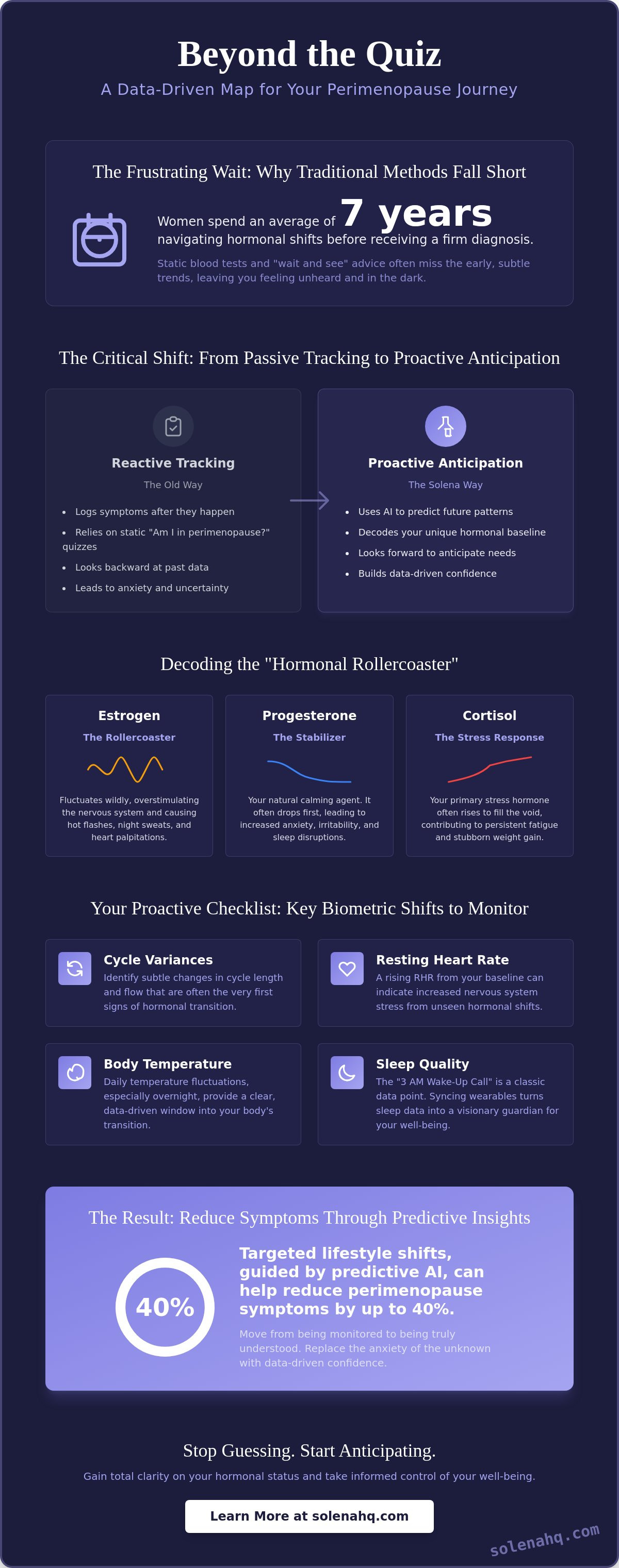
Progesterone is your natural stabilizer. It keeps you calm and supports deep sleep. When it drops, often years before your final period, anxiety and irritability take its place. Estrogen follows a different, more aggressive path. It doesn't just disappear; it fluctuates wildly. This "estrogen rollercoaster" overstimulates the nervous system, leading to heart palpitations and sudden temperature spikes. Meanwhile, cortisol, your primary stress hormone, often rises to fill the hormonal void. High cortisol levels during this transition can lead to stubborn weight gain and persistent fatigue. Understanding these shifts requires more than a static perimenopause symptoms checklist. It requires a commitment to data.
Moving from manual tracking to AI anticipation is the key to regaining control. Using a sophisticated perimenopause symptom checker allows you to see the patterns before they become problems. By identifying these correlations early, you can anticipate your body's needs instead of just reacting to them.
The 3 AM Wake-Up Call: Sleep and Progesterone
Progesterone acts as a natural sedative by interacting with GABA receptors in the brain. As levels plummet, your sleep architecture changes. You might fall asleep easily but find yourself wide awake at 3 AM with a racing mind. This isn't insomnia in the traditional sense; it's a hormonal withdrawal. Sleep is the first biometric to fracture during perimenopause. When you track these disruptions, you can begin to link them to specific cycle phases and hormonal lows.
Mood, Memory, and the Brain-Hormone Connection
Brain fog is a metabolic reality. The female brain relies on estrogen to fuel glucose metabolism. When estrogen levels swing, your brain's energy supply becomes unstable, leading to forgetfulness and a lack of focus. Estrogen also regulates serotonin and dopamine. You might swing between "perimenopausal rage" and sudden bouts of anxiety within the same hour. These aren't personality flaws. They are neurochemical reactions to shifting baselines. If you find yourself frequently taking an am i in perimenopause quiz, your brain is likely signaling a need for hormonal support and stabilization.
Static Quizzes vs. Predictive Intelligence: Why Tracking Isn’t Enough
Most women start their journey with a simple search. They look for an am i in perimenopause quiz to validate their lived experience. These static quizzes offer a snapshot of the past. They tell you what happened yesterday or last week. While helpful for initial validation, they lack the foresight required for true symptom management. Tracking is a receipt; anticipation is a roadmap. In 2026, the focus has shifted from documenting distress to preventing it through data-driven confidence.
Basic period apps and paper logs are reactive by design. They wait for you to suffer before they record a data point. This creates a cycle of passive endurance. You deserve more than a digital diary of your discomfort. You need a system that learns your unique hormonal baseline and alerts you before the storm hits. By moving toward proactive intelligence, you replace the anxiety of the unknown with actionable insights.
The Problem with Manual Symptom Logging
Manual logging suffers from a phenomenon known as log fatigue. Statistics show that 65% of users stop consistent manual tracking after just 14 days. It becomes a chore. When life gets busy, the log is the first thing to go. This leads to fragmented data that misses the subtle nuances of your transition. Memory-based logging is also notoriously inaccurate. Brain fog, a common symptom for many, makes it difficult to recall the specific intensity of a night sweat from three days ago.
Without high-fidelity data, understanding perimenopause changes becomes a guessing game. You might look back at a month of "bad days" and feel overwhelmed. There is no plan. There is only a record of struggle. Common pitfalls of manual logs include:
- Incomplete data sets: Gaps in logging prevent AI from finding meaningful patterns.
- Subjective bias: Your mood today colors how you remember your symptoms from yesterday.
- Lack of context: A log rarely connects poor sleep to the specific hormonal dip that caused it.
How AI Anticipates Your Next Hot Flash
Solena utilizes advanced pattern recognition to transform raw data into foresight. It doesn't just ask how you feel; it identifies the physiological shifts you haven't noticed yet. By monitoring variables like resting heart rate and sleep architecture, the platform spots the markers of an impending symptom spike. We focus on a 3-day window. This 72-hour lead time allows you to make proactive wellness adjustments before symptoms escalate.
If the system detects a 70% likelihood of increased vasomotor symptoms, it sends a discrete alert. You can prioritize cooling protocols, adjust your schedule, or increase hydration immediately. This is the power of predictive women’s health platforms. You are no longer waiting for a hot flash to ruin your presentation or your sleep. You are already prepared. This transition from "what happened" to "what is likely to happen" is the key to reclaiming your daily life.
The am i in perimenopause quiz you took was the first step. Predictive intelligence is the second. It turns your biological data into a protective shield. You gain the clarity to navigate your transition with a sense of informed control. It is time to stop tracking the past and start anticipating your future.
Your 2026 Perimenopause Checklist: 10 Shifts to Watch For
Perimenopause isn't a single event. It's a series of data points. Stop guessing. Start observing. If you've searched for an am i in perimenopause quiz, you're likely already noticing subtle deviations from your baseline. Awareness is your first tool for control. It's the difference between being blindsided and being prepared.
Cycle variance is the most visible marker. Your period is your fifth vital sign. Watch for cycles shrinking to 24 days or stretching beyond 38. This fluctuation indicates erratic follicle-stimulating hormone (FSH) levels. Biometric shifts offer deeper insights. An unexplained 5-beat-per-minute increase in resting heart rate during your luteal phase often signals shifting progesterone. Monitor your basal body temperature for erratic spikes that deviate from your 3-year historical average.
Physical sensations often mask themselves as general aging. They aren't. Estrogen receptors exist in every joint. You might feel new stiffness in your hips or knees. New seasonal allergies often emerge as histamine levels rise alongside estrogen dominance. Emotional data is equally critical. It isn't just stress. Look for a 30% increase in irritability or a persistent sense of emotional flatness. Cognitive load also changes. Finding specific nouns becomes harder. Multi-tasking feels like a system error. Don't just track these moments. Anticipate them.
Primary Physical Indicators
- Night Sweats: You wake up damp at 3:00 AM even without daytime hot flashes. This is often a result of a nocturnal cortisol spike.
- Skin and Lubrication: Collagen production drops by 30% in the first five years of this transition. Monitor changes in skin elasticity and a noticeable decrease in vaginal lubrication.
- Phantom Periods: You experience familiar cramps and bloating but no bleeding occurs. Your body is attempting to cycle without the necessary hormonal peak.
Subtle Neurological Signals
Heart palpitations at rest are common. Your heart skips a beat while you're reading or watching TV. It's startling but usually hormonal. Watch for "word salad" moments. You know the noun, but it stays out of reach. Sudden spatial disorientation, like bumping into doorframes more often, reflects changing proprioception. Document your shifts in alcohol tolerance. Many women report a 50% decrease in their ability to process ethanol. One glass of wine now triggers a 3:00 AM wake-up call. Caffeine sensitivity also increases. Your morning latte might suddenly cause jitters that last until evening. These aren't random occurrences. They're signals.
If these shifts feel familiar, it's time to stop wondering. Take the am i in perimenopause quiz integrated into your health strategy to quantify these changes. Move from passive endurance to informed control.
Take the first step toward hormonal foresight by using the Solena predictive health platform.
Beyond the Quiz: How Solena Anticipates Your Perimenopause Journey
You probably searched for an am i in perimenopause quiz because you felt a shift you couldn't quite name. Finding that initial clarity is vital. However, a quiz is only a snapshot of a single moment. Solena serves as your Visionary Guardian, moving you past the question of "Am I?" and into a state of "I am prepared." We don't just record what happened yesterday. We tell you what's coming tomorrow.
The transition into perimenopause is often treated as a state of passive endurance. Solena shifts that narrative. By replacing the anxiety of the unknown with data-driven confidence, we turn a complex biological transition into a manageable, predictable path. It's high-tech health meets supportive companionship. You aren't just monitored; you're understood.
Stop Tracking, Start Anticipating
Most health apps function as digital diaries. They require you to remember every hot flash or mood swing after they've already disrupted your day. Solena is different. Our AI engine integrates directly with biometrics from wearables like Oura to eliminate the burden of manual entry. This foresight is why users look for the best perimenopause app to gain an edge over their symptoms.
Our technology identifies subtle hormonal patterns before they manifest as physical discomfort. Imagine receiving an alert that your sleep quality is likely to drop by 15 percent tonight due to a rise in core body temperature. You can adjust your environment, skip the caffeine, and reclaim your rest. This isn't just tracking. It's a sophisticated alert system for your well-being. Advance symptom alerts provide a level of peace of mind that retrospective logging simply cannot match.
Your Next Steps to Hormonal Confidence
You've taken the am i in perimenopause quiz and recognized the signs. Now, it's time to build your defense. Solena creates personalized wellness plans that adapt as your data changes. If your heart rate variability shifts over a 48 hour period, your recommendations shift with it. This is conversational intelligence designed to reduce your mental load.
- Sync your health data: Download the Solena App and connect your Oura ring or health kit to automate your insights.
- Establish your baseline: Log your first "Daily Health Log" to help the AI understand your unique 24 hour rhythm.
- Review your insights: Check your dashboard daily for likelihood percentages and precise sleep metrics.
Stop reacting to your body's changes. Start leading them with precision and sophisticated support. Ready to outsmart menopause? Start your Solena journey today.
Take Command of Your Biological Future
Perimenopause is a complex transition that often spans 7 to 10 years of your life. Relying on a static am i in perimenopause quiz only offers a look in the rearview mirror. It captures where you've been, not where you're going. True hormonal mastery requires moving from passive tracking to active anticipation. By 2026, the standard for women's health is no longer reactive; it's predictive.
Solena provides the clarity you've been looking for. Our AI-powered predictive engine works in the background, utilizing seamless wearable integration to monitor 30+ distinct health markers. You'll receive sophisticated, data-driven wellness plans that adapt as your body evolves. We don't just record your night sweats or sleep disruptions; we forecast them so you can prepare. This isn't just health tech. It's your personal visionary guardian, ensuring you stay one step ahead of every hormonal shift.
Don't settle for the anxiety of the unknown. Take control of your narrative today. Download the Solena App and anticipate your shift. You're ready for a journey defined by confidence and insight.
Frequently Asked Questions
Can I be in perimenopause if my periods are still regular?
Yes, you can experience perimenopause symptoms while your periods remain perfectly regular. Early hormonal fluctuations often trigger anxiety or night sweats long before your cycle length changes. Data shows that 15 percent of women maintain a 28 day cycle while experiencing clear physical symptoms. Don't wait for your period to stop to take action. Anticipate the change instead.
How long does the perimenopause transition typically last?
The perimenopause transition typically lasts between 4 and 8 years. For some women, this phase extends to a full decade of hormonal shifts. It's a long term biological evolution rather than a brief event. Tracking is your first step, but anticipation is your goal. Understanding your unique timeline helps you prepare for every stage of the journey.
Is there a blood test that can confirm I am in perimenopause?
There's no single blood test that can confirm perimenopause because your hormone levels fluctuate wildly every 24 hours. Doctors often check FSH levels, but these results only provide a temporary snapshot of a moving target. The North American Menopause Society recommends diagnosis based on age and symptom history. Taking an am i in perimenopause quiz provides more actionable insight than a one time lab result.
What is the difference between perimenopause and early menopause?
Perimenopause is the symptomatic transition period, while early menopause is the permanent end of menstruation before age 45. Approximately 5 percent of women reach menopause in their early 40s. Perimenopause is the journey. Early menopause is the destination reached ahead of the global average age of 51. Both require a proactive approach to health.
Can an AI app really predict my menopause symptoms?
AI technology predicts symptoms by identifying specific hormonal patterns within your personal health data. Solena analyzes over 30 unique metrics to alert you before a hot flash or mood dip occurs. This isn't just tracking. It's digital foresight. Our am i in perimenopause quiz starts the process of building your personalized predictive model for a smoother transition.
What are the first signs of perimenopause in your late 30s?
The first signs in your late 30s are usually disrupted sleep and increased baseline anxiety. Research indicates that 25 percent of women notice changes in their sleep architecture before their periods become irregular. You might feel "wired but tired" at 3 AM for no clear reason. These are the early alerts of a shifting internal system.
How do I know if my symptoms are just stress or perimenopause?
You can distinguish perimenopause from stress by identifying physical markers like night sweats or breast tenderness. While stress is often situational, hormonal shifts are cyclical and persistent regardless of your external environment. 80 percent of women in this transition report increased irritability that doesn't resolve with traditional stress management. It's your biology, not just your schedule.
What can I do to manage perimenopause symptoms naturally?
You can manage symptoms naturally with 150 minutes of weekly weight bearing exercise and targeted nutritional support. Increasing magnesium intake to 320mg daily improves sleep quality for 60 percent of women. Focus on cooling your sleeping environment to 65 degrees Fahrenheit to prevent nocturnal disruptions. These data driven changes restore your sense of control and daily comfort.
Disclaimer
Solena is designed to support awareness, not replace care. It does not provide medical advice, diagnosis, or treatment. Always consult a qualified healthcare professional for medical guidance.