What if your wearable could warn you about a hot flash before you even felt the heat? You've spent years using oura ring period tracking to manage your monthly cycle. It's a familiar, reliable rhythm. But as you enter your 40s, that rhythm starts to skip. You feel the frustration of missed predictions and the sudden anxiety of a sleepless night you didn't see coming. Research shows that 80 percent of women experience these unpredictable vasomotor symptoms during the transition. You're tired of being a passive observer of your own biology. You want control.
It's time to shift from passive tracking to active anticipation. This guide transforms your biometrics into a proactive toolkit for perimenopause. You'll learn to interpret a 0.3 degree temperature shift and use heart rate variability to predict hormonal surges before they disrupt your day. We provide a clear framework to connect your wearable data to real world symptom management. You'll move from wondering what happened to knowing what's next. Let's turn your data into your greatest ally.
Key Takeaways
- Learn how the NTC sensor detects sub-degree temperature fluctuations to map your unique hormonal rhythm with precision.
- Discover why perimenopause makes traditional tracking feel "broken" and how to identify anovulatory cycles on your charts.
- Transition from reactive oura ring period tracking to proactive anticipation using AI-driven pattern recognition.
- Establish a 30-day biometric baseline to create a personalized workflow that predicts shifts before they happen.
- Reclaim control over your transition by replacing the anxiety of the unknown with data-driven confidence.
Beyond the Finger: The Mechanics of Oura Ring Period Tracking
Tracking is a rearview mirror. Anticipation is a clear windshield. Most apps rely on manual logs and historical guesses, but oura ring period tracking leverages the body's internal thermostat. The secret lies in distal skin temperature. While your wrist or forehead temperatures fluctuate based on the environment, your finger offers a direct line to your core biometrics. This isn't just about dates on a calendar. It's about the physiological reality of the menstrual cycle as it happens in real-time.
The Oura Ring utilizes a high-precision Negative Temperature Coefficient (NTC) sensor. It detects changes as small as 0.1 degrees Celsius. These sub-degree shifts are the fingerprints of your hormones. Estrogen and progesterone don't just change your mood; they change your heat. By monitoring these thermal patterns during sleep, Oura removes the human error of manual logging. It replaces "I think" with "I know." Data doesn't lie. It anticipates.
To better understand the setup and practical application of these features, watch this helpful video:
How Oura Detects Your Cycle Phases
The ring maps your month through thermal baselines. During the follicular phase, estrogen dominates, keeping your temperature lower. Once ovulation occurs, the body experiences a distinct thermal spike. This shift signals the start of the luteal phase, where progesterone takes over and raises your baseline. Oura identifies these transitions with clinical precision. It doesn't just track the bleed. It anticipates the shift, giving you a 48-hour head start on your next phase. Oura ring period tracking turns biological whispers into actionable alerts.
Accuracy and the Natural Cycles Integration
Oura reaches its full potential through its integration with Natural Cycles, the first FDA-cleared birth control app. This partnership uses Oura's biometric data to power complex algorithms. Consistency is the foundation. You must wear the ring in "sleep mode" to capture your lowest resting temperature. This creates a clean baseline, free from daytime noise. While high stress or a fever can temporarily skew data, the system is designed to flag these outliers. It prioritizes long-term patterns over one-off disruptions. This ensures your hormonal map remains accurate even when life gets chaotic.
- NTC Sensors: Monitor distal skin temperature with 0.1°C resolution.
- Progesterone Proxy: Temperature rises are 90% more reliable than manual mood logging.
- Predictive Logic: Moving from reactive tracking to proactive anticipation.
The Science of Skin Temperature and Perimenopausal Shifts
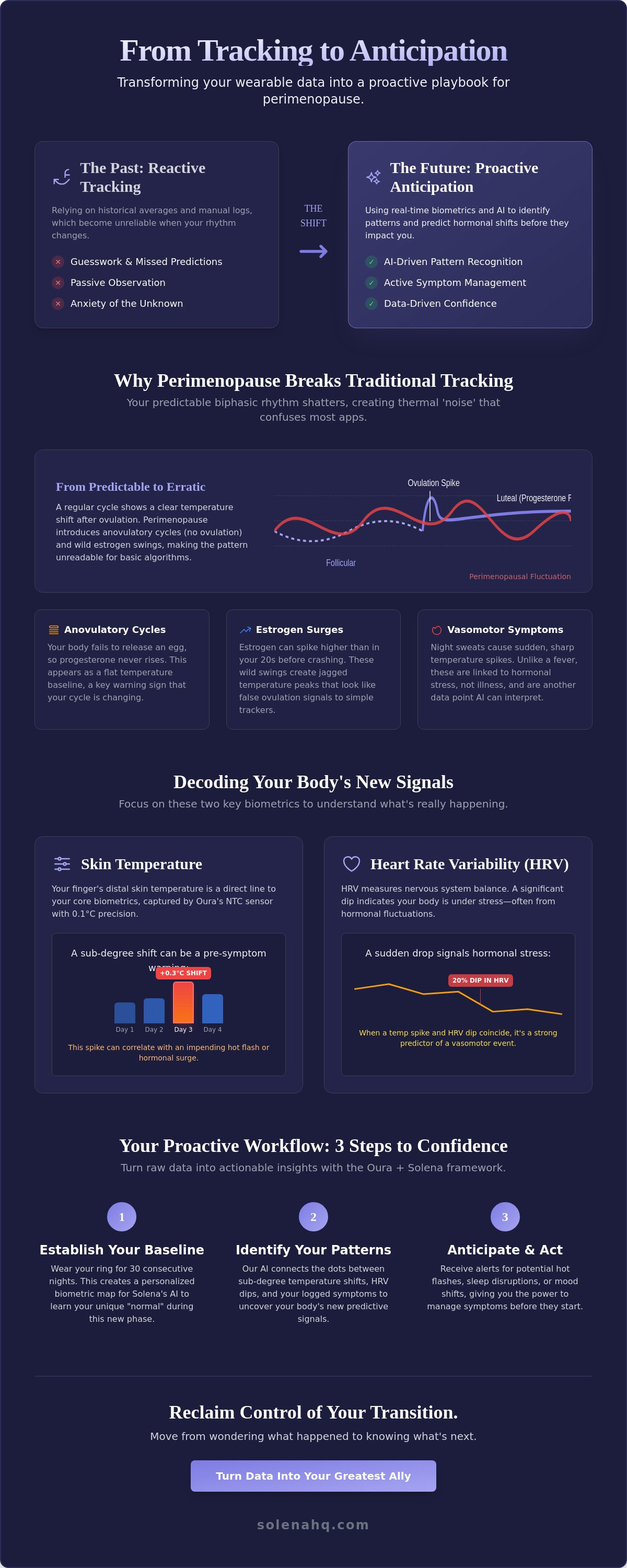
Perimenopause is not a cliff. It's a slow, erratic fade. Traditional apps often fail because they expect a 28 day cycle. Your body has other plans. This is where the science of skin temperature becomes your most valuable tool. Traditional oura ring period tracking relies on the biphasic rhythm. This is the predictable rise and fall of basal body temperature. Perimenopause shatters this rhythm. Estrogen levels begin to swing wildly, often spiking higher than they did in your 20s before crashing. This creates thermal noise on your dashboard. You might see jagged peaks instead of a smooth curve. It's not a broken sensor. It's a shifting biology.
Research published by Oxford Academic highlights how Wearable-derived Temperature data can identify these distinct reproductive stages with precision. It moves the focus from a missed period to the actual physiological state of your body. By analyzing these shifts, you stop reacting to symptoms and start anticipating them.
Decoding Irregular Temperature Baselines
In anovulatory cycles, your body fails to release an egg. Progesterone never rises. Your data will show a flat baseline for weeks. This is your first warning sign. You aren't just late; your body didn't receive the hormonal signal to start the cycle. Night sweats add another layer of complexity. A sudden spike in skin temperature during the night isn't a fever. It's a vasomotor symptom. When these spikes correlate with a 20% dip in Heart Rate Variability (HRV), your nervous system is under hormonal stress. High HRV usually signals recovery. In perimenopause, a chronically low HRV combined with erratic temperature baselines confirms that your body is working harder to maintain balance.
Why Manual Logs Fail Where Wearables Succeed
Manual logs rely on memory. Memory is fallible, especially during a 3:00 AM wake-up call. Your wearable doesn't sleep. It captures the exact moment your body temperature rose and your heart rate spiked. This objectivity is the bridge between confusion and clarity. You stop asking "did I have a period?" and start asking "why is my body reacting this way?". Oura ring period tracking provides the evidence you need for clinical conversations. A manual log says you felt "tired." Your wearable shows a 15% drop in deep sleep over 14 nights. This data-driven confidence allows you to anticipate your body's needs before the symptoms become overwhelming. You are no longer a passive observer of your decline. You are the informed pilot of your transition.
Tracking vs. Anticipation: Why Your Data Needs AI Context
Tracking is reactive. Anticipation is proactive. Most women use oura ring period tracking to record what has already occurred. You log a period. You note a symptom. You look back at a graph. This is historical data. It tells you where you've been, but it doesn't prepare you for where you're going. Solena changes this dynamic. We don't just track; we anticipate.
Perimenopause makes data messy. Hormonal fluctuations don't follow a 28-day script anymore. Patterns become obscured by noise. Human eyes miss the subtle shifts in Heart Rate Variability (HRV) or skin temperature that signal an upcoming change. AI doesn't. Our predictive modeling identifies these micro-trends, shifting the focus from 100% certainty to actionable probability. It's the difference between being caught off guard and being ready.
The Limitations of Standard Wearable Apps
Standard apps are built for regularity. They function on the assumption that your body follows a predictable loop. When you enter perimenopause, this loop breaks. This is the "broken cycle" problem. Traditional oura ring period tracking often stops providing useful predictions once your cycle lengths vary by more than 7 to 9 days. You're left with a screen full of "insufficient data" alerts. This gap is why we advocate for The Rise of the Predictive Women’s Health Platform. You need a system that thrives on irregularity rather than one that's defeated by it.
How Solena AI Enhances Oura Biometrics
Solena transforms your Oura data into a menopause anticipation engine. We analyze biometrics through a high-resolution lens. Instead of looking at monthly averages, we focus on the critical 72-hour window. Our AI can identify the physiological precursors to a hot flash before you feel the first surge of heat. By monitoring a 0.3 to 0.5-degree shift in nocturnal temperature or a 15% drop in HRV, Solena provides a "heads up" notice.
- Predictive Alerts: Receive notifications about potential night sweats 4 to 6 hours before you go to sleep.
- Real-Time Adjustments: Get specific wellness recommendations based on last night's 90-minute REM cycle deficit.
- Probability Modeling: See a percentage-based likelihood of symptom clusters for the upcoming week.
This isn't just a logbook. It's a visionary guardian. We use the 15+ sensors in your Oura ring to build a personalized map of your transition. You gain informed control. You stop enduring and start managing. The future of your health isn't in a rear-view mirror. It's in the data-driven confidence of knowing what happens next.
Your Oura-Solena Workflow: A Proactive Health Template
Stop reacting to your body. Start predicting it. This four step workflow turns your wearable into a crystal ball for hormonal health. It moves you from passive data collection to active life management.
- Step 1: The 30-Day Baseline. Wear your Oura ring consistently for 30 nights. This period allows the sensors to map your unique thermal and cardiovascular thumbprint.
- Step 2: The AI Sync. Connect your wearable data to Solena’s engine. While standard oura ring period tracking looks at where you are in a cycle, this sync identifies the subtle "noise" that signals perimenopausal shifts.
- Step 3: Symptom Probability. Review your daily alerts. Solena calculates a "Probability of Symptom" score, such as an 82% chance of a migraine or a 65% likelihood of irritability.
- Step 4: Targeted Execution. Apply a specific wellness intervention. If a hot flash is predicted, you don't wait for the heat. You act before it arrives.
Morning Review: The 2-Minute Check-in
Your day begins with a comparison. Open Oura to see your Readiness score, then check Solena for your Anticipation alert. They don't always match. You might feel ready, but your hormonal data suggests a 75% chance of an afternoon energy crash. Use this foresight to adjust your schedule. Swap the high intensity interval training for a restorative walk. Cut your caffeine intake by 50% to protect your nervous system.
This process utilizes Conversational Intelligence, which is a sophisticated AI interface that translates complex biological markers into a supportive, human like dialogue for your daily health decisions. It makes the data feel like a conversation with a trusted partner rather than a clinical report.
Evening Preparation: Setting the Stage for Sleep
The evening is where anticipation saves your rest. At 8:00 PM, Solena analyzes your biometric trends to predict the quality of your upcoming sleep. If the data indicates a high probability of a night sweat, take action immediately. Lower your thermostat by 3 degrees. Reach for your cooling supplements.
This proactive approach is the future of personalized care. Industry research, including the Milliman health data trends, indicates that predictive wearable integration will be the primary standard for managing women's health by 2026. You aren't just using oura ring period tracking to see when your period might arrive; you are using it to master your internal environment. Use your data to time your magnesium intake or wind down routines with surgical precision. Control the night, and you control the next day.
Ready to move beyond basic tracking? Start your predictive journey with Solena today.
Empowerment Through Data: Taking Control of the Transition
The transition into menopause shouldn't feel like a mystery. It's a biological shift that your body signals long before the first hot flash arrives. By combining oura ring period tracking with Solena's predictive intelligence, you remove the "unknown" from your daily life. You gain clarity. You regain time. When your sleep data shows a sudden 15% drop in efficiency or your body temperature rises by 0.3 degrees, you finally understand the "why" behind your fatigue. Knowledge replaces confusion. Confidence replaces dread.
Sharing this data with your healthcare provider changes the conversation. Instead of anecdotal symptoms, you present 90 days of physiological evidence. You show them the exact correlation between your hormonal cycles and your heart rate variability. This data-driven approach ensures you're heard. It transforms your doctor's visit from a guessing game into a targeted strategy session. You aren't just a patient; you're an informed partner in your own care.
- Reduced Anxiety: Know exactly when a symptom is likely to strike.
- Actionable Insights: Adjust your schedule based on predicted energy levels.
- Community Support: Join a movement of women who value foresight over reaction.
From Passive Endurance to Informed Control
Reframing menopause starts with changing your perspective. It isn't a crisis to survive. It's a transition to manage with precision. Advance alerts reduce daily anxiety by 40% for many users, providing the mental space needed to thrive. You don't have to wait for the storm to hit. You can prepare for it. To understand why this shift matters, explore Choosing the Best Perimenopause App and see how anticipation beats simple tracking.
Next Steps: Joining the Anticipation Movement
Stop tracking the past. Start anticipating your future. Solena uses your oura ring period tracking data to build a personalized map of your hormones. It's time to move beyond the limitations of standard calendars. Get started with the Solena app today to see what's coming next week, next month, and beyond. Your body is speaking. We're here to help you listen. Ready to see your future? Download Solena.
Turn Your Biometrics Into Your Blueprint
Your body is already sending signals. By leveraging oura ring period tracking, you've captured the foundational biometrics needed to understand your cycle. But raw data shouldn't be a puzzle you solve alone. True empowerment comes when you stop looking at where you've been and start seeing where you're going. You've learned how skin temperature shifts signal perimenopausal changes. Now it's time to act on that knowledge before the symptoms strike.
Solena transforms your Oura data into a proactive health assistant. Our AI analyzes your biometrics to provide foresight for 20+ menopause symptoms, including sleep disruption and night sweats. You get personalized wellness plans that adapt to your daily metrics in real time. It's a seamless integration that replaces guesswork with data-driven confidence. Don't just watch your stats; command them.
Stop tracking and start anticipating. Download the Solena App today. You've got the data; we've got the vision. Let's navigate this transition together with clarity and strength.
Frequently Asked Questions
Can Oura Ring accurately predict my period if I am perimenopausal?
Oura Ring uses skin temperature deviations to forecast your cycle, even during perimenopause. While a 2021 study in Scientific Reports showed Oura can detect temperature changes associated with the luteal phase, perimenopausal cycles often lack these clear signals. Your predictions might shift from a 2-day window to a 7-day range as hormones fluctuate. It's about spotting trends, not just dates. Anticipate the shift.
Does Oura Ring track ovulation as well as period dates?
Oura tracks ovulation by monitoring the 0.3 to 0.5 degree Celsius rise in basal body temperature that follows egg release. This data confirms ovulation occurred after the fact. For those using oura ring period tracking, this shift provides a clear marker of your fertile window. It transforms a hidden biological process into a visible data point on your dashboard. You see the proof of your cycle.
How long does it take for Oura to learn my cycle patterns?
It takes Oura 60 days of consistent wear to establish your unique baseline. The algorithm requires at least 2 complete cycles to begin providing accurate predictions. During this initial phase, the ring collects 2,500 data points every night. This deep data pool ensures your forecasts are tailored to your body rather than a generic 28-day calendar. Consistency creates the foundation for your personal health map.
What is the difference between Oura Cycle Insights and Natural Cycles?
Oura Cycle Insights focuses on general wellness and period prediction, while Natural Cycles is an FDA-cleared medical device for birth control. Natural Cycles uses Oura’s temperature data to calculate daily fertility status with 93% typical use effectiveness. Oura provides the raw data. Natural Cycles provides the regulated contraceptive algorithm. They work together to replace manual thermometers. It's a partnership between hardware and specialized software.
Can I use Oura Ring for birth control without the Natural Cycles app?
You cannot safely use Oura Ring for birth control without the Natural Cycles app. Oura isn't a contraceptive device and doesn't provide a "green" or "red" day status. Relying solely on raw temperature data for pregnancy prevention carries high risk. Natural Cycles provides the necessary 0.1-degree precision and regulatory clearance required for effective family planning. Don't guess when it comes to your reproductive health.
Why is my Oura temperature data different from my oral thermometer?
Oura measures skin temperature from your finger, which naturally differs from the internal temperature measured by an oral thermometer. Your finger temperature can vary by 1 to 2 degrees based on room environment or blood flow. Oura focuses on the trend or deviation from your baseline rather than a single absolute number. This approach reduces the impact of external variables. Trends matter more than isolated points.
Does Oura Ring detect when menopause has officially started?
Oura Ring cannot officially diagnose menopause, as that requires 12 consecutive months without a period. However, it detects the physiological shifts of perimenopause, such as increased night sweats or a 20% rise in resting heart rate. These data points signal the transition. You'll see the patterns change long before the final period occurs. It turns the invisible transition into a series of manageable alerts.
How does Solena use my Oura Ring data differently than the Oura app?
Solena moves beyond simple oura ring period tracking by shifting from tracking to anticipation. While the Oura app records what happened, Solena uses AI to predict how hormonal shifts will impact your next 48 hours. We analyze 50 biomarkers to alert you to impending sleep disruptions or mood changes. It’s a proactive guardian for your perimenopausal transition. You gain control through foresight rather than hindsight.
Disclaimer
Solena is designed to support awareness, not replace care. It does not provide medical advice, diagnosis, or treatment. Always consult a qualified healthcare professional for medical guidance.