

Perimenopause in your 40s isn't a biological decline. It is a complex data pattern waiting to be decoded. You might feel like an alien in your own body, waking up at 3 AM for no reason or facing unpredictable hot flashes during a work presentation. It's confusing when these common symptoms of perimenopause in 40s appear while your cycle remains regular. You aren't alone. In 2026, 83% of women report physical and mental exhaustion as their primary struggle during this transition. This isn't just a phase to endure. It's a neuroendocrine recalibration that requires foresight.
We know you want your predictability back. This guide promises to move you from reactive tracking to proactive anticipation. You'll learn to identify early warning signs and understand why your brain feels different. We'll explore actionable ways to mitigate symptoms before they peak, giving you the clarity you deserve. We're stripping away the anxiety of the unknown. We're replacing it with data-driven confidence. It's time to stop monitoring your symptoms and start mastering them.
Key Takeaways
- Reframe perimenopause as a multi-year bridge defined by hormonal volatility rather than a simple biological decline.
- Identify the common symptoms of perimenopause in 40s, ranging from shorter menstrual cycles to the "phantom" periods that signal early changes.
- Escape the "tracking trap" by shifting from backward-looking manual logs to forward-looking data anticipation with wearables.
- Regain control over your nights by optimizing your circadian rhythm to proactively address 3 AM sleep disruptions.
- Leverage AI-driven symptom alerts to decode your unique hormonal fingerprint and prepare for shifts before they occur.
The 40s Hormonal Shift: Understanding the Transition
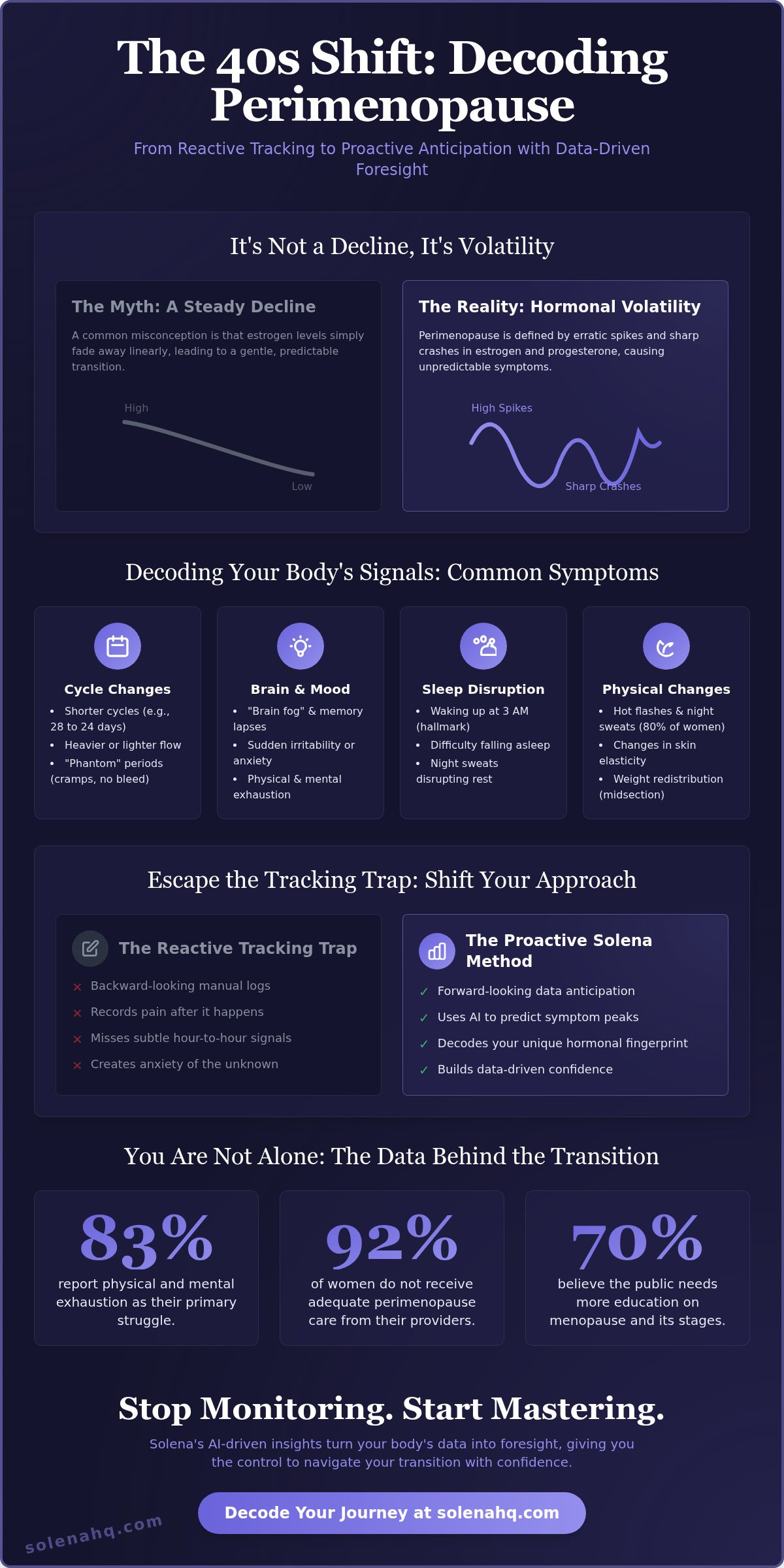
Perimenopause acts as a multi-year bridge connecting your reproductive years to menopause. For most women, this transition begins in the early 40s. It's a decade defined by subtle neurobiological shifts that often go unnoticed until they disrupt your daily flow. While many sources describe this phase as a steady decline in estrogen, that's a misconception. Perimenopause is a period of intense hormonal volatility where your system experiences erratic spikes and sharp crashes rather than a linear fade.
Understanding this distinction is vital for identifying the common symptoms of perimenopause in 40s. This "Hormonal Rollercoaster" involves fluctuating levels of estrogen and progesterone that can leave you feeling like a passenger in your own skin. To gain a deeper perspective on this shift, Understanding Perimenopause and Menopause provides essential context on how these biological stages evolve and impact your long-term health.
To better understand this concept, watch this helpful video:
The Science of the Shift
In your 40s, the communication between your ovaries and your brain begins to change. Your brain sends stronger signals to stimulate the ovaries, which often leads to erratic ovulation. This chaos directly impacts your monthly cycle and your mood. Standard blood tests often fail to catch these early signs because they provide only a single snapshot in time. They miss the hour-to-hour fluctuations that define the perimenopausal experience. Research from 2026 highlights that this transition is actually a complex neuroendocrine recalibration. It isn't just about your ovaries; it's about your brain. This recalibration includes a temporary reduction in brain grey matter and a decrease in how the brain uses glucose. These changes explain why 83% of women report mental exhaustion as one of the common symptoms of perimenopause in 40s. Your body isn't failing. It's rewiring.
Predicting the Pattern
The challenge for most women lies in distinguishing hormonal "noise" from a true signal. Most traditional tracking methods look backward. They record pain that has already happened. Solena shifts this narrative toward anticipation. By using AI to learn your specific hormonal fingerprints, the Solena App identifies patterns before they manifest as physical symptoms. This foresight is crucial in a medical environment where 92% of women do not receive adequate perimenopause care. Current 2026 data trends show a massive rise in FemTech because women are tired of being monitored; they want to be prepared. A 2025 survey indicated that nearly 70% of adult women believe the public needs more menopause education. We fill that gap by turning data into foresight. We help you anticipate the shift. You move from passive endurance to informed control.
The Most Common Symptoms of Perimenopause in Your 40s
Identifying the common symptoms of perimenopause in 40s requires looking beyond the obvious. It isn't just about hot flashes. Your menstrual cycle often provides the first clue. You might notice your 28-day cycle shrinking to 24 days. Perhaps your flow becomes significantly heavier, or you experience a "phantom" period where you have all the cramping but no bleeding. These shifts are standard common perimenopause symptoms that signal your body is entering a new phase of hormonal volatility.
Vasomotor symptoms like night sweats and daytime hot flashes are widely recognized, but they often arrive alongside less discussed changes. You might feel a sudden surge of irritability or a sense of "brain fog" that makes simple tasks feel insurmountable. Up to 80% of women experience these vasomotor disruptions, yet many don't realize they are linked to the same hormonal spikes discussed in the previous section. Physical changes also manifest in skin elasticity and weight redistribution, particularly around the midsection. Your body is changing its composition. It's a biological reality, not a personal failure.
The Silent Symptoms: Sleep and Anxiety
Waking up at 3 AM for no reason is a hallmark of the 40s transition. It's often driven by declining progesterone. Progesterone acts as your body's natural sedative; when it fluctuates, your evening calm disappears. This creates a cycle of evening anxiety and disrupted rest. Sleep quality acts as a "canary in the coal mine" for your health. If your sleep metrics are dropping, a hormonal shift is likely underway. You can explore how data-driven insights help identify these patterns before they disrupt your entire week.
Physical Indicators You Might Miss
Other signs are even more subtle. You might notice a sudden drop in libido or changes in vaginal health that feel premature. Joint pain is another frequent culprit. Many women mistake aching knees or hips for general aging, but it's often the result of fluctuating estrogen levels affecting connective tissue. These symptoms cluster together in predictable cycles that follow your unique hormonal fingerprint. Understanding these clusters allows you to move from reactive tracking to proactive anticipation. You don't have to wait for the next hot flash to know where you are in your journey. You can prepare instead.
Why Traditional Symptom Tracking Fails in Your 40s
Traditional tracking is a rearview mirror. It records the common symptoms of perimenopause in 40s after they've already disrupted your life. This is the "Tracking Trap." You spend your energy documenting yesterday's brain fog instead of preparing for tomorrow's energy crash. For a woman in her mid-40s, a retrospective journal offers little protection. It's time to shift toward a predictive women’s health platform that looks ahead.
Manual logs often fail because of the mental load they impose. In 2026, research shows that 83% of women in this transition already face significant mental exhaustion. Asking you to maintain a detailed diary is asking for labor you don't have the capacity to give. AI removes this burden. It learns your unique baseline by identifying hormonal signals within the noise. You stop wondering if your irritability is "normal" and start seeing the data-driven reality of your body's rhythm.
The Problem with Hindsight
Retrospective data can't help you navigate a hot flash during a high-stakes meeting. The "average" 28-day cycle model is a myth for a 44-year-old woman. Your body is no longer following a textbook; it's following its own volatile path. Knowing "why" you feel a certain way before the symptom peaks provides a psychological shield. It replaces the anxiety of the unknown with the calm of preparation. Considering that 83% of healthcare providers feel unconfident discussing perimenopause, having your own predictive data is your strongest asset.
The Solena Advantage: Anticipation
We move you from "What happened?" to "What is likely to happen in the next 72 hours?" Probability-based alerts change your daily experience. If you know a sleep disruption is 85% likely tonight, you can adjust your evening routine. You gain control. The Solena App serves as your visionary guardian in this shift. It doesn't just monitor you. It alerts you. It prepares you. It ensures you're always one step ahead of the transition. This is the difference between surviving the day and mastering your biology.
How to Navigate Perimenopause Symptoms Proactively
Establishing a data baseline is your first move toward informed control. By connecting the Solena App with wearable health technology, you bridge the gap between sleep metrics and hormonal shifts. This foresight allows you to identify the common symptoms of perimenopause in 40s before they disrupt your schedule. When your data shows a rise in resting heart rate or a dip in heart rate variability, it's often a signal of an impending shift. You stop reacting to your body. You start preparing for it.
Optimizing your circadian rhythm is the second step to combat the 3 AM wake-ups that plague many women. Use advance symptom alerts to adjust your evening routine 48 hours before a predicted disruption. Aligning your nutrition with your hormonal phase also provides a significant advantage. Increasing protein intake during estrogen dips helps stabilize energy levels and mood. Finally, use your high-energy windows to schedule high-stress tasks. This ensures you're working with your biology, not against it. You can start your personalized wellness plan today to master these daily adjustments.
Lifestyle as Medicine
Strength training is non-negotiable for women in their 40s. Muscle acts as your metabolic currency. It counters the weight redistribution and bone density loss that often accompany this transition. Recent 2026 studies indicate that lifestyle choices can mitigate the intensity of vasomotor symptoms by up to 40%. Alcohol and caffeine are primary triggers for night sweats; reducing these during your most volatile hormonal windows can improve sleep quality significantly. One-size-fits-all advice fails because your hormonal fingerprint is unique. You need a plan built on your specific data.
The Role of Supplements and HRT
Supplements like magnesium and Vitamin D provide essential support for sleep and bone health. However, timing is everything. Interventions are most effective when they align with your body's specific needs. For some, medical support is the right path. In November 2025, the FDA removed "black box" warnings from many HRT products, clarifying that for many, the benefits outweigh the risks. Generic HRT now costs between $10 and $60 per month, making it more accessible than in previous decades. If you're exploring progesterone for menopause, use your Solena logs to bring clear, data-driven insights to your doctor. Precise data leads to precise care. Timing your interventions based on predictive data ensures you are always one step ahead of the next shift.
Solena: Predicting Your Perimenopause Journey
Your biological transition is unique. It's a specific data pattern that deserves more than generic advice. Solena uses advanced AI to learn your specific hormonal fingerprints. We've identified the common symptoms of perimenopause in 40s, but knowing they exist is only half the battle. You need to know when they are coming for you. Our platform identifies the quiet signals in your body before they become loud disruptions. This is the power of advance symptom alerts. You don't just see a night sweat on a chart after it happens. You prepare for it days in advance.
2026 marks a turning point in women's health. An estimated 1.3 billion women will be in perimenopause this year. We are moving past the era of suffering in silence. We are entering the era of data-driven confidence. In a world where 92% of women don't receive adequate care, Solena gives you the tools to advocate for yourself. You stop being a passenger. You become the pilot. We invite you to join the movement of women moving from reactive tracking to proactive anticipation. Your data is your power.
Your Visionary Guardian
Solena is more than just an app. It's a form of "conversational intelligence" that acts as your supportive personal companion. It doesn't just deliver cold reports. It offers friendly suggestions based on your likelihood percentages and sleep metrics. The platform integrates seamlessly with your daily life and existing wearables to build a comprehensive map of your neuroendocrine health. We prioritize your security. Your health data lives within a sophisticated, private ecosystem designed to protect your well-being. It's high-tech health with a deeply human touch.
Take the First Step
Waiting for symptoms to get "bad enough" is a strategy for failure. Proactive care starts before the crisis hits. You deserve clarity on whether your experiences are "normal" and how to mitigate them before they peak. Start by taking our am i in perimenopause quiz to establish your starting point. This tool helps you identify the common symptoms of perimenopause in 40s that might be flying under your radar. Once you have your results, download the Solena app. It's free to start. No credit card is required to begin accessing AI pattern insights. Shift your narrative from passive endurance to informed control today. Your future self is waiting.
Master Your Transition
Your 40s represent a decade of peak capability, not a period of biological confusion. Mastering the common symptoms of perimenopause in 40s starts with a fundamental shift in perspective. You've moved beyond the "tracking trap" of retrospective logs. You've embraced the reality of neuroendocrine recalibration. With 83% of women in 2026 reporting mental exhaustion as a primary hurdle, the need for data-driven confidence has never been higher. You don't have to wait for the next disruption. You can anticipate it.
Solena serves as your visionary guardian throughout this transition. We offer real-time hormonal pattern analysis and AI-powered predictions that strip away the anxiety of the unknown. Our personalized wellness plans provide a roadmap for your unique biology. It's time to stop being a passenger in your own body. Stop tracking. Start anticipating. Download the Solena App today. You're joining a global movement of 1.3 billion women who refuse to suffer in silence. Step into your power. We're with you every step of the way.
Frequently Asked Questions
Is it normal to start perimenopause at 42?
Yes, starting perimenopause at 42 is entirely normal. This transition often begins between 7 and 10 years before your final period. Since the average age for menopause in the U.S. is 51, the early 40s are the standard entry point for hormonal volatility. You aren't "early." You're exactly where the biological data suggests you would be during this recalibration.
Can perimenopause cause sudden anxiety in your 40s?
Yes, sudden anxiety is a frequent neurological symptom of the transition. As progesterone levels fluctuate, your brain loses its natural calming agent. This shift can trigger a heightened "fight or flight" response, especially in the evenings. It's a biological reaction to neuroendocrine changes. It isn't a personality flaw or a simple reaction to your external environment.
How do I know if my symptoms are perimenopause or just stress?
Distinguishing between the two requires looking at patterns over time. While stress is often situational and external, common symptoms of perimenopause in 40s follow your unique hormonal cycle. These symptoms tend to cluster around specific windows, such as the days before your period. If your "stress" peaks predictably every 24 to 26 days, it's likely hormonal rather than environmental.
Will my period stay regular during early perimenopause?
Your period can remain regular while the internal shift begins. However, "regular" often changes its definition. You might see your 28-day cycle shorten to 21 or 24 days. This shortening is one of the earliest indicators of the transition. Even if you still bleed every month, the underlying hormonal spikes are already creating the volatility you feel in your daily life.
How long do perimenopause symptoms typically last in your 40s?
The transition typically spans 4 to 10 years. Because the 40s are the most common decade for this shift to start, you may navigate these changes for several years before reaching menopause. The duration is highly individual. It depends on your unique hormonal fingerprint and lifestyle interventions. Foresight helps you manage this window with informed control rather than passive endurance.
Can an AI app really predict a hot flash?
Yes, by identifying the subtle physiological signals that precede a vasomotor event. AI analyzes metrics like heart rate variability and skin temperature shifts to recognize an impending disruption. This isn't magic. It's data-driven anticipation. By learning your baseline, the technology can alert you to a likely hot flash up to 48 hours before it manifests physically, allowing you to prepare.
What is the best way to manage night sweats in my 40s?
Managing night sweats effectively requires a two-pronged approach of trigger avoidance and circadian optimization. Research from 2026 confirms that reducing alcohol and caffeine intake can lower the frequency of night sweats by 30%. Additionally, keeping your sleep environment at a consistent 65 degrees Fahrenheit helps regulate your core temperature. Anticipating these events allows you to adjust your evening routine before the sweat starts.
Should I see a doctor as soon as I notice perimenopause signs?
Yes, establishing a medical baseline is a smart, proactive move. However, go prepared with your own data. Since 83% of healthcare providers feel unconfident discussing perimenopause, showing them a detailed log of your hormonal patterns ensures a more productive conversation. You move from vague descriptions to the data-driven reality of your common symptoms of perimenopause in 40s.
Disclaimer
Solena is designed to support awareness, not replace care. It does not provide medical advice, diagnosis, or treatment. Always consult a qualified healthcare professional for medical guidance.