Tracking tells you why you're exhausted today. Anticipation tells you why you'll be awake at 3:00 AM tomorrow. For too long, oura ring cycle tracking has acted as a digital diary that simply confirms your discomfort. It logs the night sweats you already suffered or the period that arrived three days late. You're likely tired of apps that look backward while you're trying to move forward. Data fatigue is real when your biometrics offer explanations instead of solutions.
You deserve a forward-looking partner. Since the release of Menopause Insights on May 6, 2026, your ring is no longer just a monitor. It's a visionary guardian. This article teaches you how to use the Solena App and Oura's latest features to reclaim control over your hormonal health. We'll explore how the AI Advisor, launched on February 24, 2026, leverages 96.4% accurate cycle detection to provide advance warnings. You'll learn to turn biometric trends into actionable wellness plans. Move beyond passive endurance. Start anticipating your body's needs before the symptoms even arrive.
Key Takeaways
- Master the 30-day calibration phase to unlock high-resolution accuracy from your ring’s skin temperature sensors.
- Escape the "Tracking Trap" by transforming oura ring cycle tracking from a rearview mirror into a predictive GPS for your hormones.
- Evaluate the cost and functionality of Oura, Natural Cycles, and Solena to build a tech stack that actually serves your needs.
- Move beyond data logs to create actionable wellness plans that anticipate and neutralize symptoms like night sweats and mood shifts.
What is Oura Ring Cycle Tracking and How Does It Work?
Stop guessing based on a paper calendar. Most apps rely on the "rhythm method" which assumes every woman operates on a perfect 28 day loop. In reality, your body is dynamic and unpredictable. Oura Health utilizes research grade infrared sensors and NTC thermistors to capture skin temperature data directly from your finger. This is the foundation of oura ring cycle tracking. It doesn't just record a date; it measures your internal state with clinical precision.
Manual logging is prone to human error and memory gaps. Oura removes the friction entirely. By sampling your temperature up to 250 times per second while you sleep, the ring establishes a personal baseline unique to your physiology. It learns what "normal" looks like for you, even as that definition shifts. This transition from passive logging to active monitoring is the first step toward true hormonal control.
To better understand how this technology integrates into your daily life, watch this helpful video:
The Science of Basal Body Temperature (BBT)
Your core temperature isn't static. It fluctuates in direct response to progesterone levels. After ovulation, progesterone rises, causing a distinct "thermal shift" in your basal body temperature. Oura detects these subtle increases, often within 0.1 degrees Celsius. Consistent overnight data collection is vital here. The ring filters out daily stressors like evening exercise or a glass of wine to find the true signal of your cycle. This shift confirms ovulation with 96.4% accuracy, providing a level of precision that manual thermometers simply can't match.
Cycle Insights vs. Period Prediction
A period is just one event in a complex hormonal month. While traditional apps focus solely on predicting the start of bleeding, oura ring cycle tracking provides a holistic view of your follicular and luteal phases. The visual interface shows exactly where you are in your cycle at any given moment. It's not a static prediction. If your temperature stays high or drops early, the ring adjusts its forecast in real time. It respects your unique biological rhythm. This flexibility is crucial for women in their 40s, where cycles often become shorter or more erratic. You get a clear map of your hormonal landscape, not just a red dot on a calendar.
The Evolution of Wearable Tech: Tracking vs. Anticipation
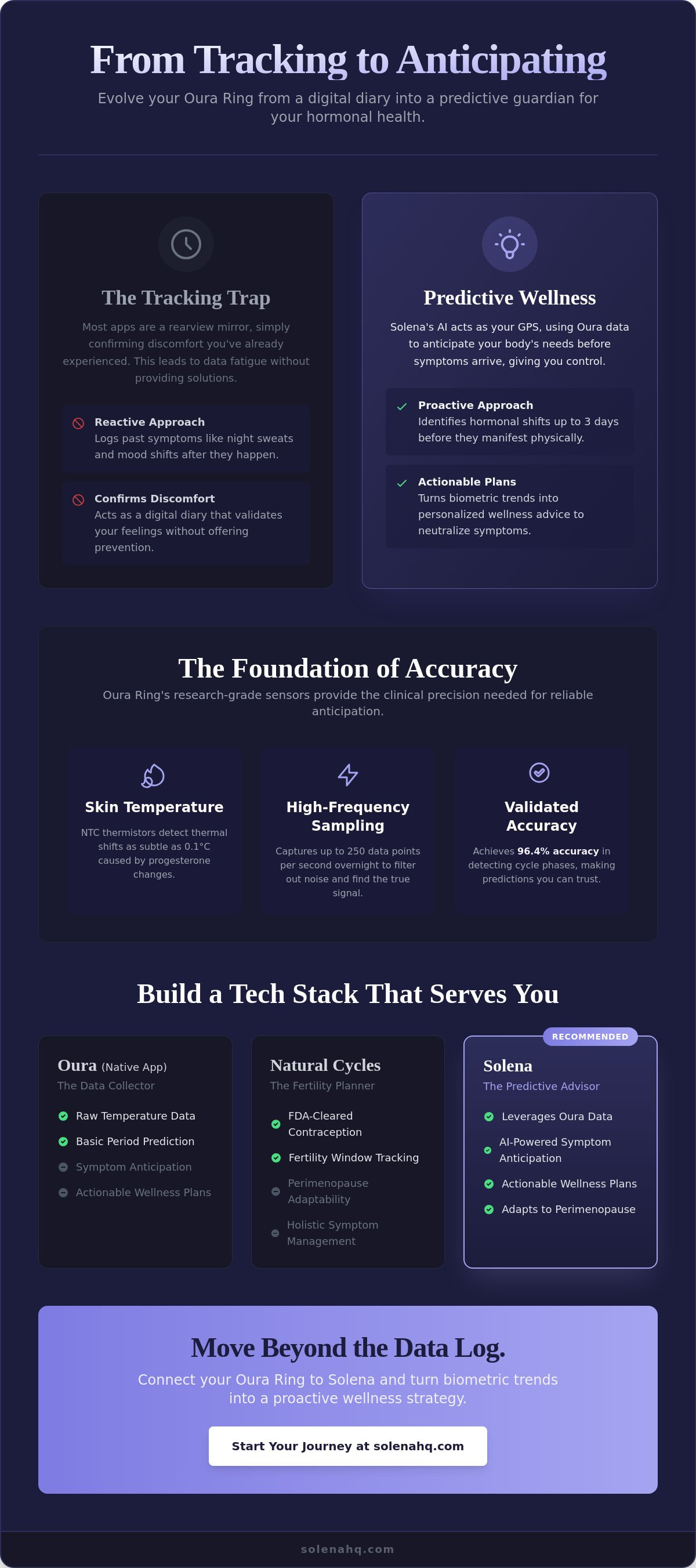
Tracking is a rearview mirror. It shows you where you've been, but it doesn't help you steer. Most women fall into the "Tracking Trap" where they spend months logging symptoms that have already occurred. This backward-looking data confirms your discomfort but does nothing to prevent it. In contrast, anticipation acts as your GPS. By leveraging oura ring cycle tracking, you can stop reacting to your body and start preparing for it. AI can now identify hormonal shifts up to 3 days before they manifest as physical symptoms.
This foresight relies on the scientific validation of Oura's accuracy in monitoring resting heart rate and temperature. Small spikes in overnight skin temperature aren't just data points. They are early warning signals. When your temperature rises while your sleep efficiency drops, your body is signaling a shift in progesterone or estrogen. Understanding this "why" before the symptoms peak provides an immense psychological relief. You aren't just feeling off for no reason; your biometrics are simply responding to a predictable biological event. Knowing this removes the anxiety of the unknown.
Why Traditional Tracking Fails in Perimenopause
The standard 28-day cycle often evaporates in your 40s. Ovulation becomes sporadic, making calendar-based apps virtually useless. When your cycles vary by more than 7 days, manual logging can't keep up with the volatility. Perimenopausal data chaos is the precursor to the urgent need for AI-driven anticipation. You need a system that adapts to your daily fluctuations rather than one that expects you to follow a textbook. If your app expects a period that doesn't arrive, it stops being a tool and starts being a source of stress.
Solena’s Predictive AI Engine
Solena takes the raw biometrics from your oura ring cycle tracking and translates them into probability. We move beyond the generic "you slept poorly" notification. Instead, our engine analyzes your specific patterns to tell you that you are 80% likely to experience a hot flash today. This is the core of the rise of the predictive women’s health platform. By seeing the disruption before it arrives, you can adjust your environment, your schedule, and your mindset. If you're ready to stop being a passenger to your hormones, you can explore how Solena empowers your transition. We turn data fatigue into data-driven confidence.
Oura Ring Comparison: Native Insights vs. Natural Cycles vs. Solena
Hardware is only half the battle. The ring collects the signal; the app provides the story. For women in their 40s, that story needs to be more complex than a simple countdown to a period. The physiological data tracked by Oura Ring includes heart rate variability and temperature shifts that reveal much more than just fertility status. Choosing the right software layer transforms oura ring cycle tracking from a basic monitor into a strategic health asset. It's the difference between recording a symptom and preventing one.
Oura Native: The Baseline Experience
Oura's native app is the gold standard for general wellness. It tracks sleep, activity, and readiness with high fidelity. For many, the built-in Oura Ring period tracking is enough to manage a predictable cycle. It offers basic reminders and a clean interface. However, it lacks specialized support for the perimenopausal transition. It won't suggest a specific wellness routine for a night sweat or warn you about a mood shift before it happens. It's a high-quality mirror, but it doesn't offer a roadmap for hormonal chaos.
Natural Cycles: Fertility Focus
Natural Cycles adds a layer of clinical validation for reproductive health. It's the premier choice if your primary goal is contraception or pregnancy planning. By syncing temperature data, it identifies your fertile window with FDA-cleared accuracy. But for women in their 40s, the goal often shifts from preventing pregnancy to managing the symptoms of declining estrogen. Our complete guide to Oura Ring and Natural Cycles explains why this tool might feel incomplete when ovulation becomes erratic. It's built for fertility, not for the volatility of the midlife transition.
Solena: The Perimenopause Specialist
Solena fills the gap left by hardware-centric platforms. We don't just log what happened yesterday. We anticipate what is coming tomorrow. While other apps stop at "you are in your luteal phase," Solena provides advance symptom alerts. We focus on the disruptions that actually impact your productivity. Sleep disruption. Hot flashes. Anxiety.
By analyzing your specific biometric trends, Solena delivers a personalized wellness plan tailored to your current hormonal state. This is the highest cost-to-value ratio for women who prioritize performance and peace of mind. These tools don't have to exist in silos. You can use Oura for the foundation and Solena for the predictive layer of your health stack. Together, they create a comprehensive shield against the unknown. You move from passive endurance to informed control.
Step-by-Step: Setting Up Oura for Maximum Cycle Insights
Precision begins at the fingertip. To get the most out of oura ring cycle tracking, you must optimize the physical connection between your skin and the sensors. Oura recommends wearing the Oura Ring 4 on your index finger for the highest quality signal. Ensure the three sensor bumps are positioned on the palm side of your finger. A snug fit is essential; if the ring rotates too freely, your overnight temperature data will be inconsistent. Establish a charging routine that keeps the battery between 30% and 80% to ensure you never miss a night of data collection. This hardware discipline is the foundation of your predictive health stack.
The first 30 days are a conversation between your skin and the sensors. This is the Calibration Phase. During this window, the Oura algorithm is not just tracking; it's learning your unique baselines. For women in their 40s, this phase is critical for distinguishing between a normal cycle shift and a perimenopausal disruption. Don't rush the process. The more consistent your wear, the more accurate your future alerts will be. By the time you reach day 31, the system can begin to separate your biological signal from daily environmental noise.
Data Hygiene for Accurate Predictions
Your biometrics don't exist in a vacuum. External factors like alcohol consumption, late meals, or travel across time zones can cause temporary temperature spikes. These "noise" events can confuse standard algorithms. To maintain accuracy, use the tagging feature in the Oura app to mark these disruptions. When you tag a "late meal" or "glass of wine," you help the AI filter out irrelevant data. This ensures your perimenopause app receives clean, actionable information. High-quality data hygiene leads to high-fidelity anticipation. It's the difference between a false alarm and a timely warning.
Interpreting Irregular Data
Perimenopause is defined by its lack of predictability. You may notice months where the ring doesn't detect a clear ovulation peak. Don't view this as a technical failure. When ovulation is absent, look to your Heart Rate Variability (HRV) as a secondary indicator of hormonal stress. A significant, sustained drop in HRV often precedes a flare-up of symptoms like anxiety or night sweats. Chaotic data isn't broken data; it's the signature of a biological transition in progress. By viewing these irregularities as meaningful patterns, you gain a deeper understanding of your body's current needs.
If you're ready to turn these biometric patterns into a personalized roadmap, download the Solena App today and start your journey toward data-driven confidence.
Beyond the Data: Turning Oura Insights into Wellness Plans
Data is a starting point, not a destination. Knowing you slept poorly is tracking. Knowing how to fix tonight's sleep is anticipation. While oura ring cycle tracking delivers high-fidelity metrics, numbers alone don't cool a hot flash or stabilize a mood swing. You need a bridge between the sensor on your finger and the choices you make in your daily life. This is where your biometrics evolve into a personalized wellness plan. It's the shift from simply observing your body to actively managing it.
A proactive routine relies on seeing the shift before the symptom peaks. If your ring detects a sustained rise in body temperature and a drop in readiness, your body is entering a high-probability symptom window. Instead of waiting for the disruption, you can adjust your environment and schedule. This might mean lowering the thermostat two degrees earlier or opting for a restorative walk instead of a high-stress meeting. You're no longer a passenger to your hormones. You're the pilot.
Personalized Routines and Supplements
Your morning should start with your Readiness Score. If Oura shows a 15% drop in heart rate variability, your nervous system is taxed. Solena analyzes these specific metrics to suggest immediate interventions. We might recommend a specific magnesium protocol or a cooling ritual hours before a predicted night sweat occurs. Over months of use, our AI refines these plans based on your body's unique response. It learns which interventions actually move the needle for your deep sleep. You aren't following a generic guide; you're following your own biological blueprint.
Empowered Conversations with Doctors
Clinical consultations are often too short for nuance. When you visit a womens clinic, don't just say you're tired. Show them the evidence. Use the Solena data export to demonstrate long-term trends that a single blood test might miss. You can move away from vague descriptions like "I feel off" and instead state, "My deep sleep has dropped 40% during my luteal phase for the last three months." This level of precision changes the clinical conversation entirely. If you're still unsure where you stand in your transition, take the am i in perimenopause quiz to validate your biometric findings. Data-driven confidence is your most powerful tool in the exam room.
Reclaim Your Hormonal Narrative
Your body isn't a mystery to be solved; it's a system to be understood. You've learned that oura ring cycle tracking is the first step toward high-fidelity awareness. By mastering the 30-day calibration phase and maintaining consistent data hygiene, you transform raw biometrics into a strategic advantage. You no longer have to wait for the night sweat to arrive to know your hormones are shifting. You can see the pattern before the disruption peaks.
The gap between tracking what happened and anticipating what's next is where your daily quality of life resides. Solena bridges this gap with an AI-powered anticipation engine designed specifically for the perimenopausal transition. You get 3-day advance symptom alerts and personalized wellness plans that adapt to your daily readiness metrics. This isn't just about monitoring; it's about informed control. You're moving from a state of passive endurance to a future of proactive health management.
Stop tracking and start anticipating with the Solena App. You possess the technology to navigate this biological transition with data-driven confidence. Your body is ready for the shift. Now, you are too.
Frequently Asked Questions
Is Oura Ring accurate for cycle tracking during perimenopause?
Yes, it's highly accurate because it relies on physiological signals rather than a standard 28 day calendar. While manual tracking often fails when cycles become irregular, Oura's 96.4% accuracy in detecting ovulation ensures you stay informed even during hormonal fluctuations. It monitors your body's thermal shifts in real time, providing a clear picture of your actual biological rhythm rather than a textbook guess.
How long does it take for Oura to learn my cycle?
Oura requires approximately 60 days of consistent wear to establish a comprehensive baseline of your hormonal patterns. The initial calibration phase takes 30 days, but the algorithm becomes significantly more precise after two full cycles. This historical data allows the oura ring cycle tracking software to distinguish between a temporary temperature spike and a true hormonal phase shift.
Do I need Natural Cycles to track my period with Oura?
No, you don't need a separate subscription to track your period. Oura's native "Cycle Insights" provides period prediction and phase analysis directly within its own app. Natural Cycles is only necessary if you require FDA cleared birth control or specific fertility planning. For symptom management and perimenopausal anticipation, the native insights combined with the Solena app are sufficient.
Can Oura Ring detect early pregnancy or menopause?
Oura doesn't provide medical diagnoses, but it identifies the biometric trends associated with these transitions. The Menopause Insights feature, released on May 6, 2026, uses a research backed questionnaire to help you understand your symptoms. Similarly, sustained temperature elevations can signal pregnancy, though you should always confirm these biometric alerts with a clinical test from your healthcare provider.
What happens to my cycle data if I have an IUD?
Your data remains useful, though the patterns depend on your specific device. If you have a copper IUD, your natural temperature shifts remain visible. Hormonal IUDs may suppress these shifts in approximately 40% of users. Since the May 2026 update, you can now track over 20 different birth control methods to see exactly how they impact your unique biometric trends.
Is the Oura Ring worth it for women over 40?
Yes, it's a vital tool for navigating the midlife transition with confidence. As estrogen levels fluctuate, traditional tracking apps become less reliable. Oura captures the physiological reality of your sleep and temperature changes, offering clarity when your calendar offers only confusion. It replaces the anxiety of the unknown with data driven insights, helping you stay ahead of unpredictable shifts.
How does Solena use my Oura data differently than the Oura app?
Oura tracks what happened; Solena anticipates what will happen. While the Oura app logs your past sleep and readiness, Solena's AI engine uses that information to provide advance symptom alerts. We translate raw biometrics into probability scores, telling you when you are 80% likely to experience a disruption. This turns passive monitoring into a proactive strategy for your hormonal health.
Can Oura Ring help with night sweats and hot flashes?
Yes, it identifies these events by monitoring sudden spikes in skin temperature and heart rate during the night. By reviewing your sleep metrics, you can see exactly how many disruptions occurred. Solena then uses this data to suggest personalized wellness plans, such as specific cooling protocols, to neutralize these symptoms before they impact your performance the next day.
Disclaimer
Solena is designed to support awareness, not replace care. It does not provide medical advice, diagnosis, or treatment. Always consult a qualified healthcare professional for medical guidance.