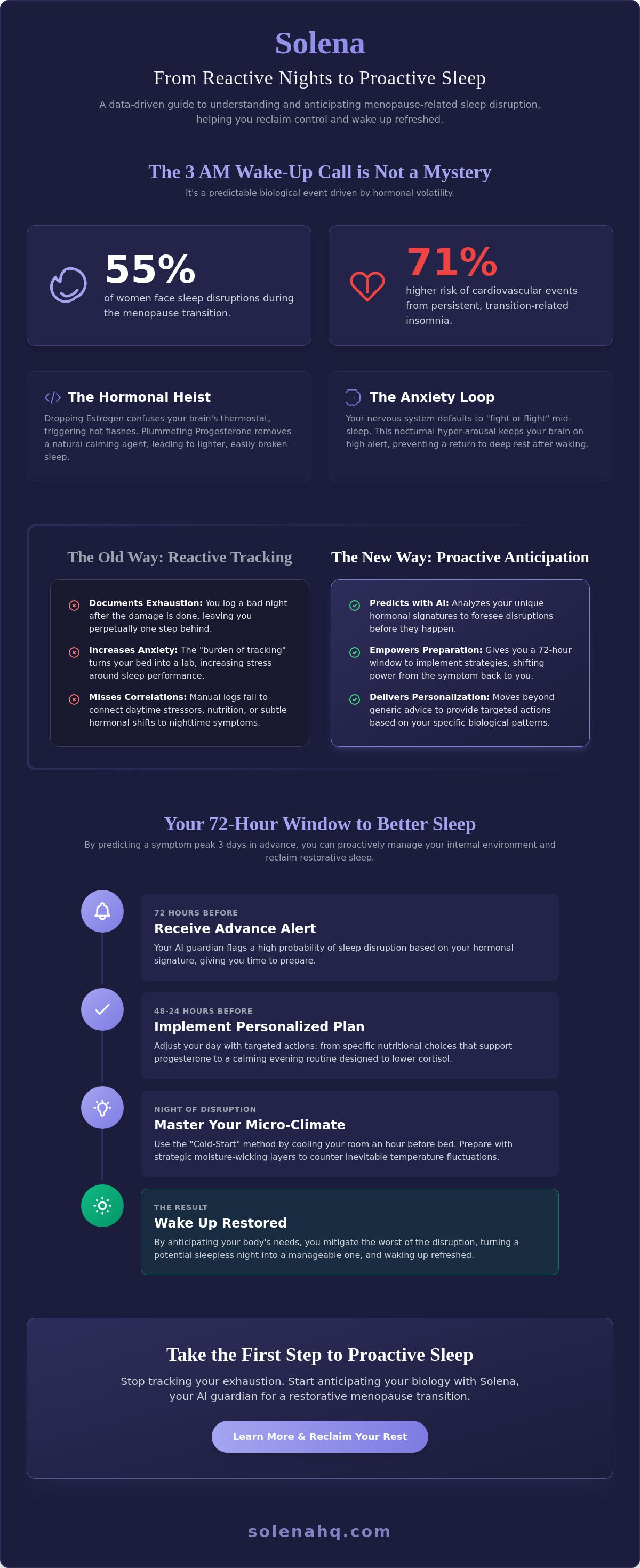
What if your 3 AM wake-up call wasn't a mystery, but a data point you saw coming twelve hours ago? Recent data from the European Journal of Endocrinology shows that up to 55% of women face these disruptions. Knowing how to improve sleep during menopause transition is no longer just about comfort; it's a critical health priority. A 2024 study from the Study of Women's Health Across the Nation (SWAN) linked persistent insomnia to a 71% higher risk of cardiovascular events. You deserve more than just surviving the night. You deserve foresight.
It's exhausting to follow every sleep hygiene rule only to end up "wired but tired" while night sweats take over. We understand that feeling of losing control. This guide transforms your approach by replacing reactive habits with data-driven anticipation. You'll learn how to predict bad nights before they happen and use personalized strategies to wake up refreshed. We'll explore the latest clinical trends and show you how to use advance alerts to stay one step ahead of your biology.
Key Takeaways
- Decode the biological triggers behind the 3 AM wake-up call and early-morning cortisol spikes.
- Shift from recording past symptoms to anticipating future disruptions with AI-driven hormonal signatures.
- Master your sleep micro-climate using the "Cold-Start" method and strategic moisture-wicking layers.
- Discover how to improve sleep during menopause transition by preparing 72 hours before a predicted symptom peak.
- Reclaim control with personalized wellness plans and advance alerts designed for restorative rest.
Understanding the '3 AM Wake-up Call': Why Transition Disrupts Sleep
The menopause transition isn't a steady, predictable decline. It's a period of extreme hormonal volatility. Your body isn't just changing; it's recalibrating under pressure. This volatility often reaches a breaking point at 3 AM. While you're trying to rest, your progesterone levels may plummet while early-morning cortisol begins to rise prematurely. This creates a biological alarm clock you didn't set. It leaves you staring at the ceiling, wondering why your body feels like it's on high alert.
Mastering how to improve sleep during menopause transition requires looking beneath the surface of your symptoms. Estrogen withdrawal directly disrupts your body's ability to regulate its internal temperature. It turns a restful night into a frustrating cycle of heat, sweat, and wakefulness. You aren't just losing sleep; you're losing the predictability of your own biology. To better understand how these changes affect your daily life, watch this helpful video:
The Hormonal Heist: Estrogen, Progesterone, and Your Internal Thermostat
Dropping estrogen confuses the hypothalamus, which is your brain's command center for temperature. It starts receiving "false" heat signals, triggering a hot flash to cool you down even when your room is freezing. At the same time, you're losing progesterone. This hormone acts as a natural GABA-agonist, a chemical that usually promotes deep, restorative rest. Without it, your sleep becomes "light" and easily broken. These hormonal shifts are non-linear. They don't follow a standard 28-day calendar. This is why traditional tracking often feels inconsistent. You can't just look at what happened yesterday; you have to anticipate what's coming tonight.
The Anxiety Loop: Why Your Brain Won't Turn Off
When hormones drop, your nervous system can default to a "fight or flight" response in the middle of the night. This isn't just standard stress; it's nocturnal hyper-arousal driven by your endocrine system. Your brain stays on high alert, scanning for threats that aren't there. We define this as the Sleep-Symptom Loop: a single night sweat triggers a spike in physiological anxiety, which then prevents you from returning to sleep. It's vital to distinguish this from clinical insomnia. This is hormone-driven sleep disruption. It requires a proactive, predictive strategy rather than just better hygiene. You need to identify the pattern before the loop begins.
The Shift from Tracking to Anticipating: Using Data to Reclaim Rest
Most advice on how to improve sleep during menopause transition starts with a diary. You write down when you woke up. You record how many times you changed your sheets. This is tracking. It’s reactive. It documents your exhaustion without solving it. By the time you’ve logged a 3 AM disruption, the damage is done. You’re already tired. You’re already behind. True control comes from anticipation. It means knowing a disruption is coming before it hits. It shifts the power from the symptom back to you.
In 2026, a modern perimenopause app should do more than just listen. It should predict. By analyzing your unique hormonal signatures, AI can spot the subtle shifts that precede a restless night. This foresight allows you to implement strategies for temperature control and relaxation hours before you even see your bedroom. It’s the difference between managing a crisis and preventing one. You aren't just surviving the transition; you're staying ahead of it.
Why Traditional Sleep Logs Fail Women in Transition
Manual logs are a burden. They ask you to focus on your failures right when you're most vulnerable. This "burden of tracking" often increases sleep anxiety. It turns your bed into a laboratory where you're both the scientist and the subject. There's also a significant lag time problem. If you only look at data after a bad night, you’re always looking in the rearview mirror. Traditional diaries also miss the crucial correlation between daytime stressors and nighttime vasomotor symptoms. They see the sweat, but they don't see the cortisol spike that caused it twelve hours earlier.
Predictive Metrics: HRV, Basal Body Temperature, and AI Insights
Your body speaks in data long before it speaks in symptoms. Heart Rate Variability (HRV) is a primary leading indicator. A sudden drop in HRV often signals that your nervous system is struggling to recover. When you integrate oura ring natural cycles data, you can see "thermal spikes" in your basal body temperature. These are tiny fluctuations that predict a night sweat with high accuracy. AI takes these complex biometrics and translates them into a simple "Likelihood of Disruption" percentage.
Imagine knowing at 2 PM that you have an 85% chance of a thermal disruption tonight. You don't just wait for it. You prepare. You adjust your evening routine. You cool your environment. You take back the narrative. Using a tool like the Solena App ensures you are never caught off guard. Anticipation is your new superpower. It replaces the anxiety of the unknown with the confidence of data.
Mastering the Micro-Climate: Practical Strategies for Temperature Control
Engineering your environment is the first step toward reclaiming your night. Generic advice often suggests keeping the room "cool," but perimenopause requires precision. We recommend the 'Cold-Start' Method. You should set your thermostat to exactly 65°F (18°C) at least thirty minutes before you enter the room. This ensures the ambient air is ready to absorb excess body heat the moment your internal thermostat fluctuates. It turns your bedroom into a recovery zone rather than a heat trap. Learning how to improve sleep during menopause transition is about these specific, measurable adjustments.
Your choice of fabric determines whether you wake up dry or drenched. Traditional cotton is a liability; it absorbs moisture but stays wet, leading to a post-sweat chill that wakes you up. Switch to moisture-wicking fabrics or high-performance bedding made from bamboo, eucalyptus, or phase-change materials. These technical fabrics actively pull heat away from the skin and dry almost instantly. Active cooling pads can stabilize core temperature during an estrogen dip. By integrating these tools, you prepare for predicted disruptions before they have a chance to break your sleep cycle.
Active vs. Passive Cooling: What Actually Works
Passive cooling, like opening a window or using a standard fan, often fails during a true vasomotor event. These methods only move existing air; they don't lower your core temperature. Active cooling solutions, such as mattress toppers that utilize water-flow or air-flow technology, provide constant thermal regulation. While "cooling" pillows offer a temporary surface fix, they can't address the systemic heat spike of a night sweat. For consistent rest, focus on technologies that maintain a steady temperature throughout the entire eight-hour window.
Light and the Circadian Rhythm in Perimenopause
Hormonal volatility makes your brain more sensitive to external cues. Estrogen shifts can actually increase your sensitivity to blue light in the evening, making it harder for your body to produce melatonin. We suggest following the 10-3-2-1-0 rule specifically adapted for this transition. This means no caffeine 10 hours before bed, no food 3 hours before, no work 2 hours before, and no screens 1 hour before. Finally, use a sunrise lamp in the morning. These devices help stabilize the cortisol awakening response, ensuring you wake up feeling alert rather than panicked. Controlling your light exposure is a vital part of how to improve sleep during menopause transition, as it anchors your internal clock when your hormones feel untethered.
The 3-Day Window: Preparing for Predicted Disruptions
Hormonal shifts aren't random events. They follow a specific biological rhythm that AI can now map with precision. The Solena Method focuses on a critical 72-hour window before a predicted symptom peak. During this time, your lifestyle choices carry three times the impact on your sleep quality. Knowing how to improve sleep during menopause transition requires this surgical focus. You don't need a perfect routine every single day. You need a strategic, high-intensity response when the data signals a high-risk night is approaching.
Preparation begins with dietary discipline. Alcohol is a significant trigger for night sweats; it disrupts the hypothalamus and spikes your core temperature. We recommend eliminating alcohol and highly inflammatory triggers, like processed sugars, during this 72-hour window. Your physical activity should also shift. High-intensity interval training (HIIT) can spike cortisol levels for hours. If an alert predicts a disruption, move your heavy workouts to low-risk days. Replace them with restorative movement to keep your nervous system calm and ready for rest.
The Pre-Emptive Routine: 72 Hours Out
Consistency in this 3-day window is more important than a perfect daily life. Start with a strict hydration protocol. Aim for 2 to 3 liters of water daily to mitigate the fluid loss caused by potential night sweats. Dehydration makes your heart work harder, which can lead to the "wired" feeling that prevents sleep. We also suggest a "Sunset Walk." This is a low-intensity, 15-minute stroll during the golden hour. It helps clear excess cortisol and signals to your brain that the day is ending. This simple habit anchors your circadian rhythm when your hormones feel untethered.
Supplementation and Progesterone Support
Timing your supplements is just as important as the dosage. When an alert signals an upcoming hormonal dip, increasing your intake of Magnesium Glycinate can be transformative. Unlike Magnesium Citrate, which can have a laxative effect, the glycinate form is highly bioavailable and specifically aids muscle relaxation and brain calm. For women using micronized progesterone, ensure you follow your prescribed schedule closely during the luteal phase. Natural "anticipation" aids like L-theanine and Apigenin are also effective. These compounds promote alpha brain waves, helping you bypass the anxiety loop before it starts. Prepare for your next high-risk window by downloading the Solena App today.
By shifting your focus to this predictive window, you stop reacting to the past and start commanding your future. You can't change the transition, but you can change how you meet it. Informed control is the ultimate remedy for sleepless nights. Use your data to build a fortress around your rest, ensuring you wake up feeling refreshed and in charge of your day.
Solena: Your AI Guardian for a Restorative Menopause Transition
Solena isn't just another tracker. It is the evolution of the predictive women's health platform, designed to give you back your nights. While other apps record what happened yesterday, Solena looks at what’s coming tonight. It integrates your daily health logs with sophisticated AI to build a living map of your hormonal landscape. This is the modern answer to how to improve sleep during menopause transition. You stop guessing. You start knowing.
The platform bridges the gap between raw wearable data and real-life action. Many women use devices like the Oura Ring but feel overwhelmed by the numbers. Solena translates those biometrics into a Personalized Wellness Plan that evolves in real-time. If your resting heart rate or body temperature shows a specific signature, your plan updates instantly. It’s a supportive personal companion that ensures you feel understood, not just monitored. You move from a state of passive endurance to one of informed control.
Personalized Wellness Plans: Beyond Generic Advice
Generic sleep hygiene is a baseline, not a solution. Solena offers a deeper level of customization by adjusting your routine based on immediate feedback. On nights where your data predicts high cortisol or hormonal volatility, the app unlocks the 'Routine Library.' This curated collection of breathwork and meditations is specifically selected for hormone-driven hyper-arousal. A plan that shifts with your unique cycle is the only way to effectively manage sleep during this transition. It replaces one-size-fits-all advice with active, informed strategy. Your plan is as unique as your biology.
Advance Alerts: Reclaiming the Power of Foresight
The most disruptive part of menopause is the unknown. The fear of a midnight wake-up often causes the very anxiety that prevents sleep. Solena’s 'Advance Alert' system removes this psychological weight. You receive a clear notification: "High risk of night sweats tonight; here is your 3-step preparation plan." This foresight changes your internal narrative. You aren't "broken" or "unpredictable." You are simply navigating a biological pattern that you now have the tools to manage. Prediction reduces the fear of the unknown, allowing your nervous system to stay calm.
Solena acts as a Visionary Guardian, staying one step ahead of your symptoms. By visualizing your likelihood of disruption through clear metrics, the app replaces dread with data-driven confidence. Your next step is simple. Start your 30-day hormonal baseline with the Solena App. Reclaim your rest. Reclaim your power. This is the future of how to improve sleep during menopause transition. Restorative sleep is no longer a mystery to be solved; it is a pattern you are finally ready to anticipate.
Take Command of Your Restful Future
You no longer have to wait for the 3 AM wake-up call to react. By mastering your bedroom micro-climate and focusing on the 72-hour window of preparation, you've already shifted from endurance to action. This proactive approach is the foundation of how to improve sleep during menopause transition. Rest is a biological requirement; it's not a luxury you should have to negotiate for every night. Control is possible when you replace guesswork with precision.
Solena provides the technological foresight to make these strategies effortless. It's time to stop looking back at what went wrong and start looking forward to what's possible. With an AI-powered predictive engine and personalized wellness plans based on your unique biometrics, you can finally stay ahead of night sweats and mood shifts. You'll receive advance alerts that turn data into a supportive, daily companion.
Download the Solena App to start anticipating your sleep patterns today. You are the expert on your body; we are simply here to provide the data-driven confidence you deserve. Wake up feeling refreshed, informed, and completely in control of your transition.
Frequently Asked Questions
Is it normal to wake up at 3 AM every night during menopause?
Yes, it's a common biological response to fluctuating hormones. Data from the University of Utah in January 2026 shows that up to 60% of women experience these disruptions during the transition. While the timing feels random, it usually aligns with the natural dip in progesterone levels. This loss of a natural sedative makes you more likely to wake during the transition between sleep stages. It's a measurable physiological shift.
Can I take melatonin for menopause-related sleep problems?
Melatonin can be effective, but it doesn't address the core hormonal cause of the transition. Research from 2024 suggests that low doses, typically 1 to 3mg, may assist with sleep onset. However, it won't stop a night sweat once it begins. You should view it as a tool for timing rather than a cure for hormonal volatility. Always check with a healthcare professional before starting new supplements.
How do I know if my sleep issues are caused by perimenopause or anxiety?
Look for physical markers like night sweats or heart palpitations to distinguish between the two. A 2026 analysis in the journal Menopause found that 40% of women experience significant sleep disturbance even without hot flashes. Perimenopause often causes sudden wakefulness, whereas anxiety usually manifests as difficulty falling asleep. Anticipating these shifts is a key part of how to improve sleep during menopause transition.
What is the best temperature for sleeping during the menopause transition?
The optimal bedroom temperature for most women in this transition is 65°F (18°C). Keeping the room at this level helps your body shed heat more efficiently during a vasomotor event. Some women find success as low as 62°F. This specific range prevents the post-sweat chill that often occurs when you're in a warmer room. It turns your environment into a proactive recovery tool.
Does HRT help with sleep during the menopause transition?
Hormone Replacement Therapy (HRT) is highly effective at reducing the vasomotor symptoms that break your sleep. By stabilizing estrogen levels, it can significantly reduce the frequency of night sweats. Clinical guidelines updated in 2025 emphasize HRT as a primary treatment for sleep issues caused by hot flashes. While Solena doesn't prescribe HRT, our data helps you track how your sleep responds to any medical treatment you choose.
How can I stop night sweats from waking me up?
You can reduce the impact of night sweats by utilizing active cooling technology and moisture-wicking fabrics. The most effective way to stop them from waking you is to prevent your core temperature from spiking in the first place. This is where anticipation beats tracking. By identifying your 72-hour high-risk window, you can adjust your hydration and cooling strategies before the sweat starts. Proactive preparation is the ultimate defense.
What supplements are best for sleep in perimenopause?
Magnesium Glycinate and L-theanine are two of the most research-backed supplements for this stage. Magnesium supports the nervous system, while L-theanine promotes relaxation without drowsiness. A 2025 review also highlighted Tart Cherry juice for its natural melatonin content. Using these strategically during your high-risk alerts helps optimize their effectiveness. Knowing how to improve sleep during menopause transition involves timing these aids with your biological needs.
How does an AI app predict my menopause symptoms?
AI predicts symptoms by identifying subtle patterns in your heart rate, temperature, and daily logs. It learns your unique hormonal signature over a 30-day baseline period. Once established, the system can spot the physiological shifts that occur before a symptom reaches its peak. It isn't magic; it's math. By processing thousands of data points, it provides the foresight you need to prepare for the night ahead.
Disclaimer
Solena is designed to support awareness, not replace care. It does not provide medical advice, diagnosis, or treatment. Always consult a qualified healthcare professional for medical guidance.