

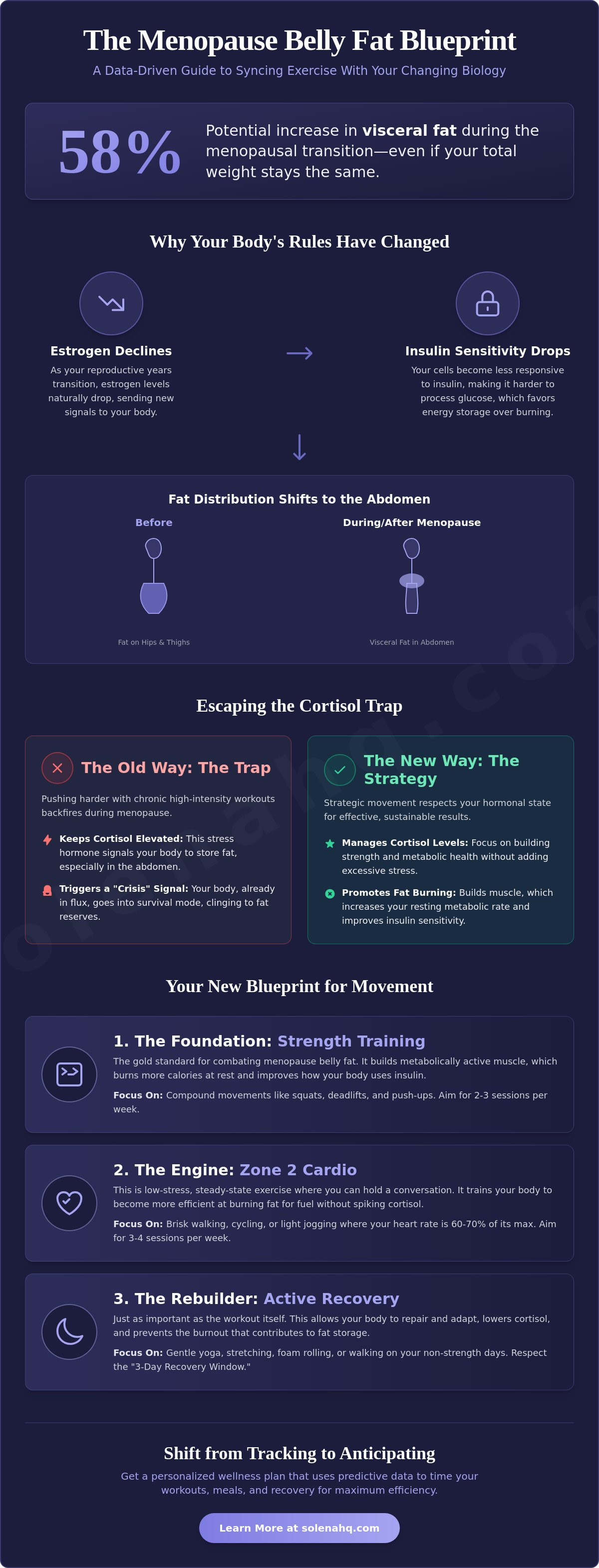
A 2026 study reveals that visceral fat can increase by as much as 58% during the menopausal transition. This happens even when your total weight barely moves. You aren't imagining the shift in your silhouette. Your biology has simply changed its rules. You need specific exercises to reduce menopause belly fat that address these hormonal shifts directly. Traditional high-intensity workouts often trigger a cortisol trap that makes stubborn fat stick. It's frustrating. Exhausting. You deserve a strategy that respects your energy levels and your time.
We understand the "menopot" isn't a lack of willpower. It's a hormonal timing problem. This guide teaches you how to sync movement with your unique fluctuations to trigger fat loss without the typical burnout. We're moving beyond basic tracking toward true anticipation of your body's needs. You'll learn to identify the exact moments when your body is primed for strength and when it requires active recovery. Discover how to build metabolic flexibility and reclaim your health with a data-driven plan built for your actual biology.
Key Takeaways
- Understand how declining estrogen levels impact insulin sensitivity and shift fat distribution toward the abdomen.
- Identify the most effective exercises to reduce menopause belly fat by prioritizing compound movements and Zone 2 cardio for metabolic health.
- Learn why high-intensity routines can trigger the cortisol trap and how to adjust your intensity to prevent fat storage.
- Leverage predictive data to time your workouts around energy fluctuations and sleep quality for maximum efficiency.
- Shift from passive tracking to proactive anticipation with personalized wellness plans that adapt to your unique hormonal rhythm.
Why Menopause Belly Fat Happens: The Estrogen-Insulin Connection
Menopause belly isn't just a change in your size. It's a change in your location. As your reproductive years transition, your body undergoes significant hormonal changes in fat distribution. Estrogen levels drop. Fat that once settled on your hips and thighs begins to migrate to your center. This isn't a failure of willpower. It's a biological pivot. Your body is changing its storage strategy, and you need to change your response.
The primary driver is a shift in insulin sensitivity. As estrogen wanes, your cells become less responsive to insulin signals. This makes it harder for your body to process glucose efficiently. Instead of burning energy, your system defaults to storage. This storage happens deep within the abdominal cavity. Visceral fat is an active endocrine organ that secretes inflammatory cytokines and directly disrupts your metabolic health. It's different from subcutaneous fat, which sits just under the skin. You can pinch subcutaneous fat; visceral fat is hidden, wrapping around your liver and heart. This hidden fat is the specific target of exercises to reduce menopause belly fat.
To better understand the biological mechanics of this shift, watch this helpful breakdown:
The Science of the 'Menopot' Shift
Hormonal fluctuations act as a signal. They tell your body to protect your vital organs by padding them with energy. This happens at the same time you face sarcopenia, or age-related muscle loss. A 2024 global meta-analysis found that 64.13% of women report physical exhaustion during this phase. Less muscle means a lower resting metabolic rate. The old "calories in, calories out" model fails because it ignores this 58% increase in visceral fat potential. Your body is in a state of high alert. If you slash calories or over-exercise, you simply increase the stress response.
Identifying Your Personal Fat Distribution Pattern
You can't manage what you don't measure. Use a simple waist-to-hip ratio to assess your risk. A ratio above 0.85 often indicates higher levels of visceral fat. It's also vital to distinguish between transient bloating and actual fat accumulation. Data helps you see the difference. Your 2026 wellness plan must prioritize hormonal balance over the number on the scale. We focus on anticipation. By understanding your unique patterns, you can select the right exercises to reduce menopause belly fat before the cortisol trap takes hold. Don't just track the change. Prepare for it.
The Cortisol Trap: Why Your Old Workouts Might Be Backfiring
Pushing harder isn't the answer. In fact, it's often the problem. During perimenopause, your body becomes hyper-sensitive to cortisol. This stress hormone is essential for survival. In excess, however, it signals your system to store fat specifically in the abdominal region. Chronic high-intensity cardio, like long-distance running or back-to-back spin classes, can keep cortisol levels elevated for hours. For a body already navigating hormonal flux, this is a crisis signal. It's a trap that makes even the most consistent exercises to reduce menopause belly fat feel useless.
You need a proactive strategy. Reactive exercise is pushing through fatigue because you feel you must. Proactive movement respects the 3-Day Window. This is the 72-hour period where your hormonal recovery is most vulnerable. The 3-Day Window is a predictive recovery model. It accounts for the slower cellular repair cycles that occur as estrogen declines. If you stack high-stress workouts without this window, you aren't building muscle. You're just accumulating systemic stress. A 2024 global meta-analysis found that 64.13% of women report physical and mental exhaustion during this transition. Ignoring this data doesn't make you stronger. It makes you more prone to visceral fat storage.
HIIT vs. Strength Training for Hormonal Health
HIIT has its place, but it's a double-edged sword. While it burns calories, the recovery cost is high in your 40s and 50s. Resistance training remains the gold standard for exercises to reduce menopause belly fat because it builds the metabolic machinery you need. Muscle acts as a metabolic sink. It soaks up excess glucose and improves insulin sensitivity without the massive cortisol spike associated with long-duration cardio. When you lift weights, the repair process requires significant energy. Your body draws from glucose stores for up to 48 hours after the session. By building lean mass, you change your body's baseline. You become more efficient at burning fat even when you aren't moving.
Signs Your Workout is Increasing Your Belly Fat
Watch for the 'tired but wired' feeling. It's a major red flag. If you're physically exhausted but your mind is racing after a gym session, your cortisol is peaking at the wrong time. This leads to more belly fat, not less. Monitoring your recovery metrics is essential to ensure you aren't overtraining. Solena helps you anticipate these low-energy windows so you can swap a heavy lift for restorative movement. Don't force a high-intensity session when your data suggests recovery. Anticipate the slump. Prepare for the peak. This is how you shift from tracking symptoms to controlling your outcome.
Best Exercises to Reduce Menopause Belly Fat: A Strategic Framework
Efficiency is your new metric. You don't have energy to waste on movements that don't serve your hormonal goals. A strategic framework for exercises to reduce menopause belly fat prioritizes compound movements. These exercises recruit multiple large muscle groups simultaneously. This approach maximizes your caloric burn during the session. It also stimulates the production of growth hormone, which naturally declines during the menopausal transition. You aren't just burning fat. You're rebuilding your metabolic foundation.
Mitochondrial health is equally vital. Your mitochondria are the power plants of your cells. Incorporating Zone 2 steady-state cardio helps these power plants process fat more effectively. This is low-intensity movement where you can still hold a conversation. It builds your aerobic base without triggering a stress response. Since 65.43% of women experience joint and muscular discomfort according to 2024 research, mobility work is no longer optional. It's a prerequisite. Dynamic stretching and joint circles prepare your body for heavier loads. Protect your progress by moving well before you move heavy.
Resistance Training: The Foundation of Fat Loss
Focus on goblet squats and deadlifts. These movements engage the glutes, hamstrings, and core. They create a massive metabolic demand that isolation exercises like bicep curls can't match. Progressive overload is the key to success here. You must gradually increase the weight or resistance to keep challenging your muscles. Don't let your routine stagnate. Aim for the sweet spot of 2 to 3 days of lifting per week. This frequency allows for the necessary recovery window. It ensures you build the lean mass needed to manage glucose levels without exhausting your system.
Core and Stability: Moving Beyond the Crunch
Traditional crunches often fail to reach the deeper layers of the abdomen. They can also increase internal pressure and strain the neck. When selecting exercises to reduce menopause belly fat, stability must come before intensity. Use the Wood Chop evolution. This rotational movement targets the obliques and transverse abdominis. These muscles act as a natural corset for your midsection. Plank variations are superior for protecting the lower back while torching visceral fat. For a truly sophisticated approach, integrate hypopressive breathwork. This technique reduces abdominal pressure. It can actively decrease waist circumference by retraining the deep core muscles to stay engaged. It's about functional stability. It's about informed control over your silhouette.
Anticipatory Movement: Using Data to Time Your Workouts
Static workout calendars are a relic of the past. Your body's capacity for intensity doesn't stay the same from Monday to Friday. It shifts with your hormones. AI-powered health technology now allows you to predict low-energy windows before they happen. This foresight is critical when choosing exercises to reduce menopause belly fat. If your system is already stressed from a night of poor sleep, a high-intensity session won't burn fat. It will likely stall your progress. The best exercise is the one your body is hormonally prepared to handle right now.
Sleep quality is the foundation of fat oxidation. When your sleep is disrupted, your body's ability to burn fat during exercise can drop significantly. In 2026, we use a sophisticated framework for "Cycle Syncing" that works even when your period is irregular. By monitoring basal body temperature and symptom clusters, we can identify your virtual hormonal phases. This allows you to plan high-impact sessions for when your estrogen provides a natural energy boost. It ensures every movement you make is optimized for your current internal environment.
Step 1: Analyze Your Daily Health Logs
Tracking what happened yesterday is a report card. Anticipating what will happen tomorrow is a strategy. By using Solena's predictive tools, you can spot upcoming fatigue patterns before they derail your week. Night sweats are a prime example. These disruptions often lead to a measurable drop in next-day physical performance. When you see a high likelihood of sleep disruption in your forecast, you can adjust your schedule. Move your heavy lifting to a day when your data shows peak readiness. This is how you master exercises to reduce menopause belly fat without the exhaustion.
Step 2: Sync with Your Wearables
Data from your wrist or finger provides the most accurate intensity guidance. Leveraging advanced hormonal tracking insights allows you to monitor Heart Rate Variability (HRV) trends in real-time. A declining HRV is a clear signal to pivot. If your plan calls for a heavy deadlift session but your recovery score is in the red, listen to the data. Pivot to restorative yoga or a Zone 2 walk. This maintains your metabolic momentum without triggering a cortisol spike. You're working with your biology, not against it.
Step 3: Implement the 3-Day Wellness Plan
A rigid schedule is the enemy of hormonal health. Instead, craft a flexible 3-day plan that accommodates "High Likelihood" symptom days. This approach ensures you never miss a beat, even when your cycle is unpredictable. In this updated framework, active recovery days are just as important as strength days for maintaining metabolic flexibility. Advance AI alerts prevent workout burnout by suggesting a restorative session precisely when your system needs it most. You can start your personalized wellness plan today to see how anticipation changes your results.
Beyond Movement: The Solena Approach to Menopause Wellness
Movement is only half the battle. To truly master exercises to reduce menopause belly fat, you must address the underlying hormonal landscape. Solena acts as a Visionary Guardian in this space. We shift your focus from surviving symptoms to anticipating them with data-driven clarity. Our personalized wellness plans adjust in real-time as your body changes. If your data suggests a dip in insulin sensitivity, we alert you immediately. We help you prepare for the shift. By addressing the root cause-your hormones-every minute of exercise becomes 10x more effective. You aren't fighting your body anymore. You're leading it with sophisticated foresight.
By 2030, an estimated 1.2 billion women worldwide will be navigating this transition. You don't have to do it blindly. The trend in women's health is shifting from reactive to proactive care. We use wearables and daily health logs to guide preventative measures. This isn't just about weight. It's about metabolic flexibility and long-term vitality. When you align your lifestyle with your biological reality, the results follow naturally. You stop guessing. You start knowing.
Predictive Nutrition to Fuel Your Workouts
Muscle protein synthesis slows significantly during perimenopause. You need precise protein timing to see the full benefits of your strength training. Solena helps you manage blood sugar spikes to prevent new visceral fat storage before it begins. A 2026 study revealed that visceral fat can increase by as much as 58% during this transition. This happens even with minimal weight change. Nutrition is the essential shield that protects your metabolic progress. Our technology predicts when hormonal shifts might trigger specific cravings. We alert you before the urge hits. This foresight keeps your nutrition perfectly aligned with your movement goals. You stay in control of your fuel and your results.
Taking Control of the Transition
Stop reacting to the scale. Start anticipating your biology. Data-driven confidence replaces the anxiety of the unknown. Knowledge is your most powerful tool for health. Use the perimenopause symptom checklist to identify specific patterns in your journey. This information is invaluable when you speak with your healthcare provider. While we don't provide medical consultations or HRT prescriptions, we equip you with the daily logs and advance alerts to make every medical conversation count. Take the lead in your health journey. It's time to move from passive endurance to informed control. Start anticipating your symptoms with Solena today.
Reclaim Your Metabolic Power
You've moved beyond the outdated myth that more cardio equals more fat loss. You now understand that a 58% increase in visceral fat potential is a biological pivot, not a failure of willpower. By prioritizing compound movements and respecting the 3-Day Window, you can finally see results from your exercises to reduce menopause belly fat. The transition from reactive tracking to proactive anticipation is your most powerful tool. You don't have to guess how you'll feel tomorrow. You can know.
Regain control with AI-powered hormonal pattern prediction and personalized wellness plans built on real-time data. Join women globally who use our visionary guardian approach to navigate this transition with data-driven confidence. Stop tracking and start anticipating your menopause symptoms with the Solena App.
You are in the driver's seat of your health. Your body is changing. Now, you have the technology to change with it. Move forward with clarity.
Frequently Asked Questions
Can you really lose menopause belly fat with just exercise?
Exercise alone is rarely the complete answer because it doesn't address the underlying hormonal drivers. You must combine strategic movement with proactive nutrition and stress management to counter the 58% increase in visceral fat potential seen in 2026 studies. Anticipating your low-energy windows prevents the cortisol spikes that often stall progress. It's about working with your biology rather than just increasing your activity levels.
What is the single best exercise for menopause belly?
The goblet squat is the most effective single movement for most women. It recruits multiple large muscle groups and stimulates the production of growth hormone, which naturally declines during the transition. These compound exercises to reduce menopause belly fat build the metabolic machinery needed to soak up excess glucose. They turn your body into a more efficient energy burner even while you're at rest.
How often should a menopausal woman work out to see results?
Three days of resistance training per week is the metabolic sweet spot. This frequency allows for the essential 3-Day Window of recovery required for cellular repair as estrogen levels drop. Stacking high-intensity workouts every day often leads to systemic exhaustion. A 2024 global meta-analysis showed that 64.13% of women struggle with fatigue. Respecting your recovery needs ensures you build muscle without triggering fat storage.
Does walking reduce menopause belly fat effectively?
Walking is highly effective when performed as Zone 2 steady-state cardio. This low-intensity movement improves mitochondrial health and oxidizes fat without elevating cortisol levels. It's an accessible tool for the 65.43% of women who report joint and muscular discomfort during perimenopause. Consistency in Zone 2 training builds a strong aerobic base. This foundation allows your body to handle more intense sessions when your data shows peak readiness.
Why am I gaining weight in my stomach but nowhere else during menopause?
Declining estrogen levels signal your body to shift fat distribution from your hips and thighs to your abdomen. Your cells also become less sensitive to insulin during this transition. This shift creates a biological preference for storing energy as visceral fat around your vital organs. It's a systemic pivot that requires a change in strategy. You aren't doing anything wrong; your body is simply following a new hormonal blueprint.
Is HIIT safe for women in perimenopause?
HIIT is safe but requires precise timing to be effective. High-intensity intervals can spike cortisol, which may trigger fat storage if your system is already stressed by night sweats or poor sleep. Use predictive health data to schedule HIIT only on days when your recovery metrics are high. If you're feeling "tired but wired," swap the intensity for restorative movement. This proactive approach prevents burnout and protects your metabolism.
Can I reduce visceral fat without Hormone Replacement Therapy (HRT)?
You can absolutely reduce visceral fat through data-driven lifestyle changes. While the FDA removed the "black box warning" from HRT products in February 2026, the choice to use medication is deeply personal. Regardless of your medical path, your exercises to reduce menopause belly fat must be synced with your unique hormonal rhythm. Focusing on insulin sensitivity and muscle preservation remains the foundation of success with or without hormonal intervention.
How long does it take to see changes in menopause belly fat?
Most women notice a measurable reduction in waist circumference within 12 weeks of starting a hormonally-synced plan. Real-time data helps you stay consistent by adjusting your intensity before you hit a wall. By anticipating fatigue and symptoms, you avoid the common burnout cycles that lead to quitting. You'll likely feel energy improvements within the first 14 days. Physical changes to your silhouette follow as your metabolic flexibility improves.
Disclaimer
Solena is designed to support awareness, not replace care. It does not provide medical advice, diagnosis, or treatment. Always consult a qualified healthcare professional for medical guidance.