

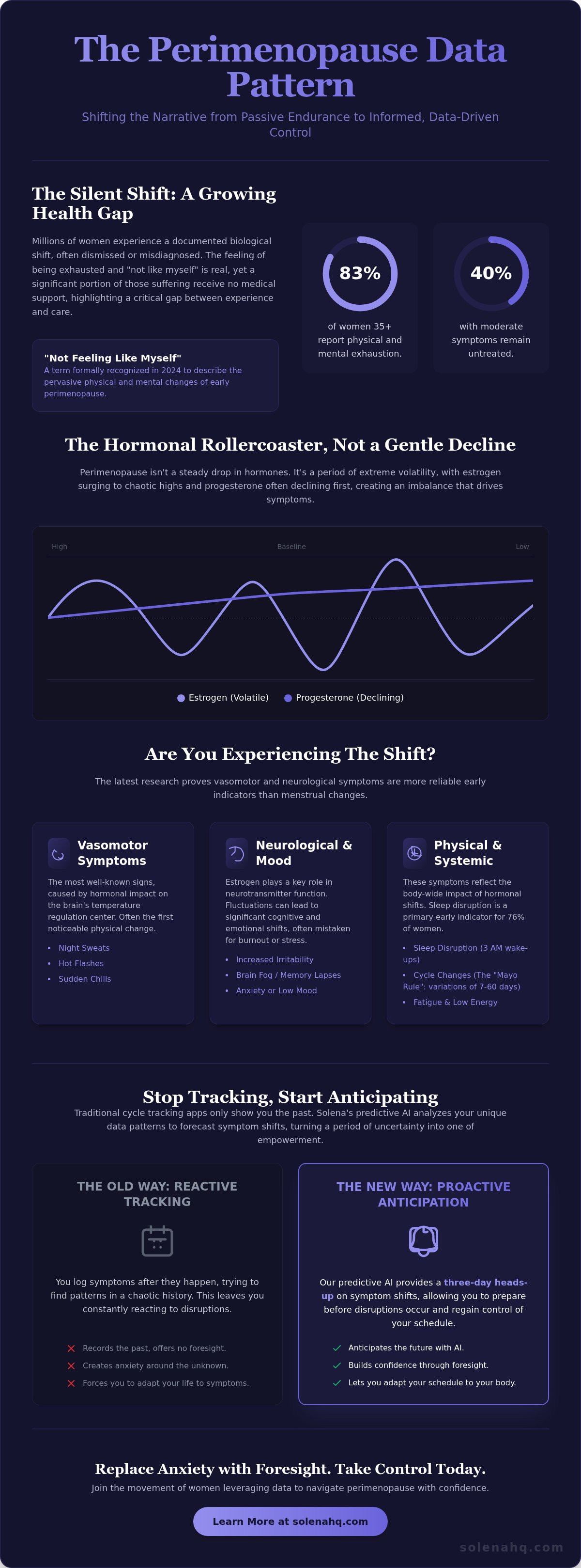
83% of women aged 35 and older now report physical and mental exhaustion, yet a 2025 study in The Lancet reveals that 40% of those with moderate symptoms remain untreated. You might be staring at the ceiling during a 3 AM wake-up, wondering how to know if you are starting perimenopause when your cycle still feels mostly regular. It's a frustrating gap between what you feel and what traditional medicine tracks. You aren't imagining the irritability. You're experiencing a documented biological shift often called "Not Feeling Like Myself," a term formally recognized in 2024.
We believe perimenopause is a data pattern to be anticipated, not a mystery to be solved. This guide will help you validate your experience using 2026 global research, which proves that vasomotor symptoms are more reliable indicators than menstrual changes. We're shifting the narrative from passive endurance to informed control. You'll gain a clear framework for self-assessment and learn how to use proactive alerts to regain your schedule. It's time to replace the anxiety of the unknown with the confidence of data-driven foresight.
Key Takeaways
- Understand the biological bridge. Perimenopause is defined by fluctuating hormones rather than just a steady decline, creating a unique "rollercoaster" pattern.
- Identify the "great mimics." Learn to distinguish between early hormonal shifts and other conditions like chronic stress or burnout that often cloud a diagnosis.
- Master the "Mayo Rule." Use specific cycle variations of seven to sixty days as a clear indicator of how to know if you are starting perimenopause.
- Shift from tracking to anticipation. Predictive AI can provide a three-day heads-up on symptom shifts, allowing you to prepare before disruptions occur.
What is Perimenopause? Defining the Menopausal Transition
Perimenopause isn't a cliff. It's a biological bridge. This multi-year transition serves as the prelude to menopause, typically beginning for most women between the ages of 35 and 55. While many assume this phase is defined by a steady decline in estrogen, the reality is far more chaotic. It's a season of erratic hormonal spikes and sudden crashes. Your body isn't just slowing down; it's recalibrating. Understanding how to know if you are starting perimenopause requires looking past the surface. The start is often invisible to the naked eye, yet it's clearly visible in your biological data. This shift represents a fundamental change in how your brain and ovaries communicate.
This transition is often misunderstood as a simple countdown. It's actually a complex process where your body prepares for a new life stage. According to the latest 2025 research from Monash University, identifying these subtle shifts through symptom patterns is now considered more accurate than waiting for cycle irregularities. What is Perimenopause? It's the period where your endocrine system begins its final major transformation, a process that can last up to a decade. By identifying these patterns early, you move from a state of passive endurance to one of informed control.
To better understand this biological shift, watch this helpful video from an expert in the field:
The Difference Between Perimenopause and Menopause
The distinction between these two stages is often blurred in casual conversation. Menopause is a single point in time. It's the date that marks exactly 12 months without a menstrual period. Perimenopause is the entire "puberty in reverse" phase leading up to that moment. During this time, your body follows a unique rhythm:
- Hormonal Volatility: Unlike the steady state of menopause, perimenopause is characterized by high highs and low lows.
- Fertility Window: You are still ovulating. Even if your cycles are irregular, you can still get pregnant.
- Symptom Onset: Many women experience their most intense symptoms, like night sweats and mood irritability, years before their periods actually stop.
If you're wondering how to know if you are starting perimenopause, look at the frequency and intensity of these shifts rather than just the calendar. It's a period of high biological activity, not just a gradual winding down.
Why 2026 is the Year of Proactive Menopause Care
2026 marks a turning point in women's health. We've moved past the era of "grin and bear it" and entered the age of data-driven wellness. We no longer rely on vague guesses or waiting for cycles to fail. Modern AI models now identify early hormonal markers with incredible precision, allowing us to see the transition before it disrupts your daily life. Perimenopause is a transition that begins in the brain’s hypothalamus before the ovaries. By focusing on these early neural signals, we replace the anxiety of the unknown with sophisticated foresight. We don't just track what happened yesterday; we anticipate what's coming tomorrow. This shift in perspective turns a period of uncertainty into a period of empowerment.
The Biology of the Shift: Why You Feel Different
Perimenopause is a high-stakes dance. Estrogen doesn't just drop. It surges and retreats. Progesterone often vanishes first, leaving estrogen unopposed. This imbalance creates the physical friction you feel. The Biology of the Shift is rooted in this volatility. Your Follicle Stimulating Hormone (FSH) acts as an early alarm. It rises as your brain tries to jumpstart sluggish ovaries. This "shouting" from the brain happens long before your cycle length changes. If you're wondering how to know if you are starting perimenopause, your FSH levels and estrogen spikes tell the story before your period does. It's an internal signal that the transition has begun.
Sleep quality is your early warning system. It's the canary in the coal mine. 76% of women in a 2026 global study reported sleep problems as a primary symptom. Most apps just record that you slept poorly. They track the past. We focus on the 3-Day Window. This is the critical timeframe where hormonal fluctuations become predictable. By identifying the specific hormonal dip before it happens, you can adjust your evening routine. You move from wondering why you're tired to knowing exactly when to prioritize rest. Anticipating these shifts turns a restless night into a manageable pattern. You gain the foresight to prepare your environment before the disruption starts.
The 3 AM Wake-Up: Cortisol and Estrogen
Suddenly waking up at 3 AM is a biological signature. When estrogen dips during the night, your blood sugar can destabilize. This triggers a cortisol spike to bring it back up. Cortisol is your "alert" hormone. It leaves you feeling "tired but wired" in the middle of the night. It's a common search for those trying to figure out how to know if you are starting perimenopause. You aren't just awake; your body is reacting to a chemical shift. This spike happens because the brain perceives the estrogen drop as a stressor. Understanding this link helps you stop blaming your lifestyle and start supporting your biology.
Conversational Intelligence: How Your Language Changes
Your words carry clues. Irritability and brain fog are more than just "bad days." They are data points. 80% of women report increased irritability during this transition. AI now identifies these cognitive glitches through pattern recognition in your daily health logs. Subtle changes in how you describe your day often precede a physical hot flash. This conversational intelligence helps you see the invisible. You recognize the "brain fog" as a hormonal event rather than a personal failing. By noticing these linguistic shifts, we can alert you to upcoming mood changes before they impact your relationships or work.
Perimenopause or Something Else? Making the Distinction
Identifying the shift is complicated by conditions that mimic hormonal changes. Burnout and chronic stress often masquerade as early menopause. Exhaustion, reported by 83% of women in a 2026 global study, can stem from adrenal fatigue or actual perimenopause. Determining how to know if you are starting perimenopause involves parsing these overlaps. Clinical anxiety is a persistent state. In contrast, "peri-anxiety" often follows a cyclical, hormonal rhythm that spikes just before a period. This distinction is vital for accurate care. You shouldn't be treated for a mental health disorder if your brain is simply reacting to an estrogen crash. Use a Perimenopause Symptom Checklist to see if your experiences align with biological markers or lifestyle stressors.
Data-driven confidence strips away the anxiety of the unknown. When you see a pattern, you regain control. It's not just about what you feel. It's about when you feel it. Stress doesn't usually follow a 28-day cycle. Hormones do. By mapping these disruptions, you can present your doctor with a clear framework for self-assessment. This prevents you from being dismissed. It turns a vague conversation into a clinical dialogue. You aren't just a patient; you're an informed partner in your own health journey.
Perimenopause vs. Pregnancy: The Overlap
Breast tenderness and missed periods are hallmark signs of both conditions. For women in their 40s, a pregnancy test remains a necessary first step. Fatigue levels in early pregnancy can mirror the exhaustion of hormonal shifts. For a deeper dive into these similarities, read Pregnant or Menopause? How to Tell the Difference. Understanding these nuances prevents unnecessary panic. It replaces guesswork with clarity. You need to know which biological bridge you're crossing before you can prepare for the destination.
The Thyroid Connection
Hypothyroidism is a frequent mimic. It presents with weight gain, thinning hair, and cold intolerance. These symptoms overlap heavily with the 77% of women reporting depressive moods during the transition. Solena tracks sleep patterns and basal temperature to help you see the difference. A thyroid issue often shows a consistent temperature drop. Perimenopause shows a volatile, "rollercoaster" pattern. Ask your doctor for a full thyroid panel if your data shows a flatline rather than a fluctuation. Hormone testing alone is rarely enough. You need the full picture of your metabolic health. This ensures you treat the root cause, not just the symptom. You move from being monitored to being understood.
The 2026 Perimenopause Symptom Checklist
The "Mayo Rule" provides the first clinical benchmark for cycle changes. Early perimenopause is defined by a variation of seven days or more in your cycle length. Late transition is marked by a gap of 60 days or more. These numbers aren't suggestions; they're biological indicators. If you're looking for how to know if you are starting perimenopause, your calendar is a vital witness. However, the physical shift often precedes the calendar. Night sweats aren't just "feeling hot." They're waking up damp, needing to change your sheets, and feeling a sudden chill afterward. You might also notice breast tenderness, increased skin dryness, and the emergence of the "peri-belly," where weight shifts toward the abdomen despite no change in diet.
Modern health involves more than just observation. It requires precision. We focus on the "invisible" signs that your body is working harder to maintain balance. A rising Resting Heart Rate (RHR) or a sudden decrease in Heart Rate Variability (HRV) often signals a hormonal shift before you feel a single symptom. By monitoring these biometric markers, you move from reactive tracking to proactive anticipation. You can start using advance symptom alerts to prepare your body for these shifts before they peak. This data-driven approach replaces the anxiety of the unknown with actionable foresight.
Biometric Markers You Can Track Today
Wearables have revolutionized our understanding of the transition. You can use an Oura Ring to see hormonal shifts in your temperature data with high accuracy. These devices capture the subtle rise in basal body temperature that occurs when progesterone fluctuates. A drop in HRV can signal a hormonal dip 48 hours before a hot flash. This data gives you a window of opportunity to adjust your hydration, cooling, and schedule. It's the difference between being blindsided and being prepared. You aren't just monitoring your body; you're staying one step ahead of it.
Mood and Cognitive Checklist
The mental shift is often the most jarring part of the transition. You might experience a sudden "rage" or irritability that feels entirely out of character. This isn't a personality flaw. It's a neurological response to fluctuating estrogen. If you're wondering how to know if you are starting perimenopause, pay attention to these cognitive signals:
- Sensory Overload: Feeling overwhelmed by bright lights or loud noises that never bothered you before.
- Word Loss: "Losing" common words mid-sentence or struggling with concentration.
- Unexplained Irritability: A short fuse that seems to ignite without a clear external trigger.
These "glitches" are documented symptoms of the hormonal rollercoaster. Recognizing them as biological events allows you to respond with self-compassion rather than frustration. You are simply navigating a complex neural recalibration. By identifying these patterns in your daily log, you can anticipate mood shifts and regain control over your social and professional schedule.
Stop Tracking, Start Anticipating: Taking Control with Solena
Manual logs are a rearview mirror. They record the disruption after it ruins your morning. Basic apps tell you that you slept poorly yesterday. We tell you how you'll sleep tomorrow. This is the core of the Visionary Guardian approach. Solena moves you from a state of passive endurance to one of informed control. By analyzing your unique Daily Health Logs, our predictive AI identifies the subtle hormonal shifts of early perimenopause before they manifest as physical symptoms. You don't just wonder how to know if you are starting perimenopause; you see the evidence in your personalized data patterns. We replace the anxiety of the unknown with sophisticated foresight.
Our approach is built on the power of the 3-day window. This timeframe allows you to prepare for shifts in energy, mood, and temperature. Instead of reacting to a hot flash, you receive an Advance Symptom Alert. You gain the clarity needed to adjust your environment and your expectations. Your Personalized Wellness Plan isn't a static document. It's a living routine that adapts to your daily biometric data. It's a supportive personal companion that ensures you feel seen and understood rather than just monitored. You're no longer at the mercy of a biological rollercoaster. You're the one in the driver's seat.
Moving Beyond the Period Tracker
Traditional trackers were built for fertility. They look for the peak of ovulation. The menopausal transition requires a completely different lens. Choosing the Best Perimenopause App: Why Anticipation Beats Tracking is about choosing foresight over history. Instead of a static calendar, Solena provides likelihood percentages. A notification might alert you to a 70% chance of sleep disruption tonight based on a 15% drop in your HRV. This insight changes your behavior. You might choose a cooling eye mask or skip the evening caffeine. You prepare. You adapt. You stay in control of your schedule and your sanity.
Your First Step: The Solena AI Engine
The journey starts with your unique "normal." Every woman's transition is distinct. Our AI engine requires a baseline to begin its predictive work. As you use your Daily Health Logs to record energy, mood, and sleep, the system builds a sophisticated profile of your hormonal rhythm. This transition from reactive anxiety to data-driven confidence is immediate. You aren't just monitoring a change; you're mastering it. Your wellness plans evolve with you, offering specific recommendations for every biological shift. Download the Solena App to start anticipating your transition today. It's time to stop wondering how to know if you are starting perimenopause and start owning the process with the confidence of data.
Your Data-Driven Path Forward
You don't have to guess about the biological changes happening inside your body. By applying the "Mayo Rule" to your cycle and monitoring biometric markers like HRV, you've gained a clear framework for how to know if you are starting perimenopause. We've moved from the era of "grin and bear it" to a future of predictive health. You understand that your 3 AM wake-ups and cognitive glitches aren't personal failings. They are data points in a larger hormonal pattern. You aren't just a passenger in this transition. You're the pilot.
Solena was featured in the 2026 Predictive Health Trends for its ability to turn history into foresight. We provide AI-powered 3-day symptom alerts and personalized wellness plans that adapt to your unique biology. It's time to stop looking at the past and start preparing for your future. Stop tracking and start anticipating with the Solena App. You have the tools to navigate this transition with sophistication and calm. Your body is changing. Now, you're ready for it.
Frequently Asked Questions
How do I know if I am in perimenopause or just stressed?
Look for cyclical patterns in your data rather than random occurrences. Stress usually lacks a 28-day rhythm. Perimenopausal symptoms, like the 77% of women reporting depressive moods in 2025 research, often follow specific hormonal ebbs. Mapping these shifts helps you identify how to know if you are starting perimenopause versus experiencing high-functioning burnout. Data provides the distinction that feelings alone cannot.
At what age does perimenopause usually start?
Most women enter this transition between the ages of 35 and 55. While the average onset is 45, individual variability is high. 2026 global studies show that 83% of women over 35 already report fatigue and mental exhaustion. These early markers often appear years before a missed period. Your biological age matters less than your specific hormonal data patterns.
Can I still get pregnant if I am starting perimenopause?
Yes, pregnancy is still possible until you have gone 12 consecutive months without a period. You are still ovulating, even if your cycle varies by the seven days defined in the Mayo Rule. Because hormonal spikes are erratic, fertility remains a factor. Always use a pregnancy test to rule out overlap when periods become irregular or breast tenderness increases during the month.
What are the first signs of perimenopause in your 40s?
The earliest indicators are often vasomotor symptoms and sleep disruptions rather than cycle changes. A 2025 Monash University study confirmed that night sweats and vaginal dryness are more reliable early signs than menstrual irregularity. You might also notice a decrease in heart rate variability or a rise in resting heart rate. These biometric shifts often signal the transition before you feel a physical hot flash.
Is there a test to confirm I am in perimenopause?
No single blood test can definitively diagnose this transition because hormone levels fluctuate wildly from day to day. Doctors typically use a combination of age, symptoms, and menstrual history for diagnosis. Identifying how to know if you are starting perimenopause relies on tracking symptom patterns over time. Predictive data models are now more effective than one-time FSH tests for capturing the full biological picture.
How long does perimenopause usually last?
This biological bridge typically lasts between four and ten years. It is a multi-year process of recalibration rather than a sudden event. During this time, you move through early and late stages characterized by different cycle lengths. Using proactive alerts helps you manage this decade-long shift by anticipating disruptions before they impact your daily productivity or mental well-being.
Can an AI app really predict my menopause symptoms?
Yes, by identifying patterns in your daily health logs and biometric data. AI models analyze your unique baseline to provide a 3-day heads-up on potential shifts. This isn't just tracking the past. It's about anticipation. Knowing there is a 70% likelihood of sleep disruption allows you to adjust your routine and prepare your environment. It turns biological uncertainty into informed control.
What happens if I start perimenopause in my 30s?
Starting in your 30s is known as early perimenopause and affects approximately 5% of women. It requires the same data-driven approach as onset in your 40s. Focus on logging subtle shifts like sudden irritability or 3 AM wake-ups. Early identification allows you to implement wellness plans sooner. This foresight ensures you maintain control over your health during a longer transition period.
Disclaimer
Solena is designed to support awareness, not replace care. It does not provide medical advice, diagnosis, or treatment. Always consult a qualified healthcare professional for medical guidance.