

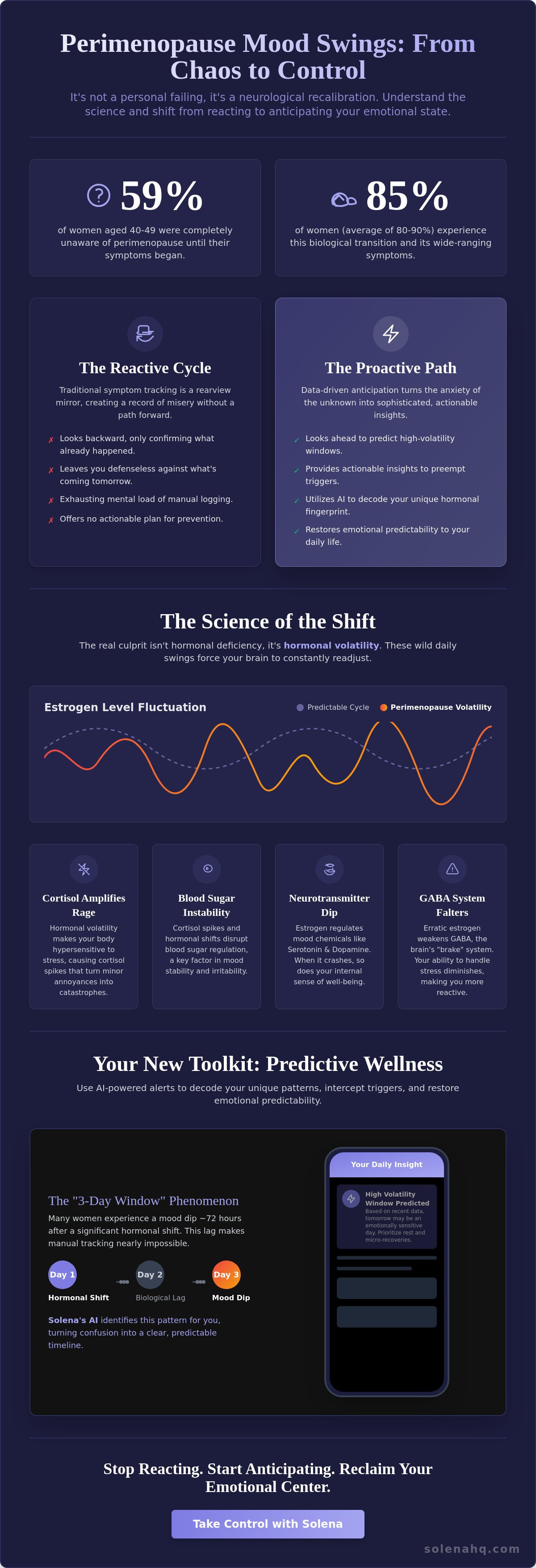
What if the "rage" you felt yesterday wasn't a character flaw, but a data point you could have seen coming? It's exhausting to feel like a stranger to yourself while navigating unpredictable irritability and relationship strain. A 2025 survey found that 59% of women aged 40 to 49 were completely unaware of perimenopause until their symptoms began. You aren't losing your mind; you're experiencing a biological transition that 80% to 90% of women face. Learning how to manage perimenopause mood swings requires a shift in perspective. Stop reacting. Start anticipating.
You probably believe that tracking symptoms is enough. It isn't. Tracking looks backward; anticipation looks ahead. We're here to help you move beyond simple logs to proactively manage your emotional health using data-driven foresight. This guide shows you how to replace the anxiety of the unknown with sophisticated, actionable insights. We'll explore tech-enabled strategies, the impact of sleep disruption on your mood, and how the latest 2026 FDA updates on treatment options change your roadmap to stability. It's time to reclaim your emotional center with confidence.
Key Takeaways
- Reframe perimenopause as a neurological recalibration to shift from passive endurance to informed control. It's a biological shift, not a personal failing.
- Learn how to manage perimenopause mood swings by moving beyond backward-looking tracking toward proactive, data-driven anticipation.
- Identify the specific roles of cortisol and blood sugar in amplifying hormonal rage so you can intercept triggers before they escalate.
- Discover how to use micro-recoveries and pre-emptive routines to stabilize your nervous system during high-volatility windows.
- Utilize AI-powered symptom alerts to decode your unique hormonal fingerprint and restore emotional predictability to your daily life.
Why Perimenopause Mood Swings Feel So Jarring
You aren't losing your mind. The sudden, white-hot rage or the tears triggered by a simple commercial aren't personal failings. They are biological responses to a brain undergoing a massive neurological recalibration. While 2024 meta-analysis data shows joint pain is the most common physical symptom of this transition, the emotional toll is often what feels the most disruptive to your daily life and relationships. Understanding how to manage perimenopause mood swings begins with acknowledging that your brain is being rewired in real-time. Validation isn't just about feeling heard; it's about understanding the mechanics. When your hormones swing significantly in a single day, your brain's emotional centers are under siege. This is why you feel like a stranger to yourself.
To better understand why these emotional shifts feel so intense, watch this helpful video:
Perimenopause mood swings are a biological response to wildly fluctuating estrogen levels rather than a steady, predictable decline. This erratic volatility is what distinguishes this stage from the "normal" PMS you may have navigated in your 20s or 30s.
The Estrogen-Serotonin Connection
Estrogen acts as a master regulator for the neurochemicals that dictate your mood. It manages serotonin and dopamine, the chemicals responsible for happiness and motivation. When estrogen levels spike and crash, your brain experiences a sharp neurochemical dip. This isn't just a bad mood. It's a physiological drop in the molecules that help you stay calm and focused. When you dive into the science of perimenopause, you see how progesterone withdrawal also plays a role. Without enough progesterone to act as a natural sedative, your brain's ability to handle stress diminishes. You become more reactive because your internal buffering system is effectively offline.
Why 'Tracking' Often Fails to Provide Relief
Most women start by logging their symptoms in a journal or a basic calendar. They record the rage after it happens. They note the insomnia after a sleepless night. This creates a record of misery but offers no path forward. Traditional tracking is a rearview mirror. It tells you what happened yesterday, but it leaves you defenseless against what's coming tomorrow. The mental load of manual logging is also exhausting, especially when you're already feeling overwhelmed by irritability. Learning how to manage perimenopause mood swings effectively means moving from a reactive state to a predictive one. You don't need a ledger of your past. You need a sophisticated perimenopause app that identifies patterns before they peak. Stop reacting. Start anticipating.
The Science of the Shift: Hormones and Your Brain
Most clinical discussions focus on hormonal deficiency. In perimenopause, the real culprit is hormonal volatility. It isn't just that your estrogen is low; it's that it's swinging wildly from day to day. These spikes and crashes force your brain to constantly adjust its neurochemistry. This volatility also triggers a rise in cortisol, your primary stress hormone. As your estrogen fluctuates, your body becomes hypersensitive to stress. A minor inconvenience that you would have brushed off three years ago now feels like a catastrophe. This heightened reactivity is a hallmark of the transition. Understanding this biological sensitivity is the first step in learning how to manage perimenopause mood swings with data-driven confidence.
Timing is everything when it comes to your emotional health. Many women experience a "3-Day Window" where a significant hormonal shift manifests as a mood dip exactly 72 hours later. This lag makes manual tracking nearly impossible for the human brain to decode. Advanced AI technology identifies your unique hormonal signature to predict precisely when your mood might dip based on these complex patterns. By recognizing these cycles, you move from wondering why you're upset to knowing it was mathematically probable. You can explore how AI anticipates these shifts to regain your sense of agency.
Neurotransmitters Under Fire
Hormonal shifts directly impact GABA, the brain's natural "brake" system. When estrogen levels are erratic, GABA falters. This leaves your nervous system stuck in a state of high alert, leading to both irritability and the cognitive clouding known as brain fog. These aren't separate issues; they are two sides of the same hormonal coin. Identifying your perimenopause symptom checker early warning signs is vital for intervention. Medical experts at Johns Hopkins provide extensive resources on Perimenopause symptoms and treatments, highlighting that mood changes are often the first sign of the transition. Catching these shifts early allows for proactive management rather than desperate reaction.
The Sleep-Mood Feedback Loop
Your emotional resilience is built during REM sleep. Unfortunately, perimenopause targets this exact phase. Night sweats can wake you up multiple times, even if you don't fully realize you're awake. This fragmentation destroys your ability to regulate emotions the following day. Research from early 2026 indicates that sleep quality is the number one predictor of mood stability for perimenopausal women. There is a direct, data-backed connection between a 3 AM wake-up call and 3 PM irritability. When you see the metrics, the "rage" feels less like a personal failure and more like a predictable result of sleep deprivation. Learning how to manage perimenopause mood swings effectively requires prioritizing the restoration of your sleep-mood feedback loop through targeted, proactive alerts.
Reaction vs. Anticipation: A New Management Framework
Most strategies for how to manage perimenopause mood swings focus on damage control. You feel the "rage," you react, and then you spend the next day apologizing. This is reactive management. It's exhausting. The Solena Method replaces this cycle with proactive alerts. Instead of wondering why you're suddenly irritable, you receive a notification that your hormonal volatility is high today. This shift in perspective changes everything. You aren't just enduring a symptom; you're managing a predictable event. When you see a "75% likelihood" of a mood shift on your dashboard, your anxiety drops. It isn't a mystery anymore. It's just data.
Anticipation allows for the "Pre-emptive Routine." This means acting before the cortisol spike hits its peak. If you know a high-volatility window is opening, you can adjust your schedule. You might skip a high-stress meeting or prioritize a 10-minute nervous system reset at noon. By the time the hormonal shift occurs, your body is already buffered. You've moved from a state of passive endurance to one of informed control.
| Reactive Management | Predictive Management |
|---|---|
| Manual logs recorded after the crash. | AI alerts sent before the shift. |
| Guessing why you feel "off." | Data-driven confidence in your patterns. |
| Post-event regret and relationship strain. | Pre-emptive routines and emotional stability. |
Stop Tracking, Start Anticipating
Manual logs are a chore. During an emotional crisis, the last thing you want to do is open an app and describe your anger. This is why predictive women's health platforms are essential. They remove the mental load. You stop asking "What did I feel?" and start asking "What will I feel?" This forward-looking approach strips away the shame. You realize your mood isn't a personality flaw. It's a biological metric that can be anticipated and prepared for with precision.
Leveraging Your Wearable Data
Your body signals a mood shift long before your mind perceives it. Subtle changes in heart rate variability (HRV) and skin temperature are early warning signs of hormonal turbulence. By integrating tools like the Oura Ring and Natural Cycles, you get a deeper look at your internal state. These wearables capture the raw data, and Solena turns it into a wellness plan for your next 24 hours. If your HRV is low and your temperature is rising, your resilience is down. We alert you so you can prepare. That's the power of anticipation.
Actionable Strategies for Immediate Emotional Relief
Learning how to manage perimenopause mood swings requires a move from abstract advice to physiological intervention. When your data signals a high-volatility window, your strategy must shift. It's no longer about "getting through the day." It's about intercepting biological triggers before they reach a tipping point. This isn't a personality fix. It's a biological stabilization. By implementing targeted resets during your most vulnerable hours, you reclaim your emotional baseline. Here is your four-step proactive plan for immediate relief.
The Blood Sugar-Mood Connection
Glucose stability is your first line of defense. A blood sugar crash mimics the physical symptoms of an anxiety attack, which quickly amplifies perimenopausal rage. Protein-first meals are non-negotiable for emotional health during this transition. Aim for 25 to 30 grams of protein at breakfast to prevent a midday cortisol spike. Avoid the glucose roller-coaster by always pairing carbohydrates with healthy fats or fiber. Practical snacks like Greek yogurt with chia seeds or apple slices with almond butter keep your baseline steady. These small choices prevent "hanger" from turning a minor annoyance into a major outburst when your hormones are erratic.
Implementation is most effective when timed with your predicted hormonal shifts. Use these strategies to buffer your nervous system:
- Micro-Recoveries: Dedicate 5 minutes to nervous system resets three times a day. Try box breathing or splashing cold water on your face to stimulate the vagus nerve. 2025 research suggests these frequent, short breaks are more effective for perimenopausal emotional regulation than one long meditation session.
- Intensity Adjustment: If your wearable data shows low heart rate variability (HRV), scale back. Swap a high-intensity interval training (HIIT) session for a restorative walk. Pushing through physical exhaustion only fuels evening irritability.
- Targeted Supplements: Magnesium glycinate and Vitamin B6 support GABA production and neurotransmitter balance. Use them as part of a consistent, proactive routine rather than a one-off fix during a crisis.
Protecting Your Relationships
Unpredictable irritability often leads to accidental conflict and post-event regret. Anticipation changes this narrative. Use your advance symptom alerts to initiate an "Early Warning" conversation with those around you. Tell your partner or colleagues that your data shows a high-sensitivity window for the next 48 hours. This isn't an excuse. It's a sophisticated boundary. Setting expectations before the irritability peaks allows for strategic withdrawal. You can choose to step away for 10 minutes rather than reacting in the heat of the moment. This preserves your relationships and reduces the mental load of constant apologies. To start receiving these predictive insights for your daily life, get your personalized wellness plan here.
Predictive Wellness: Taking Control with Solena
Perimenopause shouldn't feel like a series of emotional ambushes. Most traditional advice tells you to wait for the storm to pass. We believe you should know the storm is coming. Solena acts as your Visionary Guardian, bridging the gap between complex clinical data and your daily reality. By shifting the narrative from passive tracking to active anticipation, you reclaim your agency. You are no longer at the mercy of erratic shifts. You are one step ahead. This is the ultimate tool for anyone learning how to manage perimenopause mood swings with sophisticated precision.
Your body is unique. A generic calendar cannot capture your specific biological rhythm. Solena's AI learns your unique hormonal fingerprint over time. It analyzes your sleep metrics, heart rate variability, and logged symptoms to build a predictive model tailored specifically to you. This isn't a post-event report. It's a foresight tool. It helps you understand your internal climate before it escalates into irritability or relationship strain. Data-driven confidence replaces the anxiety of the unknown. You aren't losing control; you're gaining a partner that sees what you can't.
Your Personalized Wellness Plan
Static health advice often fails because perimenopause is dynamic. A plan that works on Monday might be useless by Thursday if your estrogen crashes. Solena generates Personalized Wellness Plans that adjust in real-time. If the AI detects a 3 AM wake-up or a dip in your recovery metrics, your routine for the day shifts automatically. It might suggest a specific protein-to-carb ratio for your next meal or a 5-minute nervous system reset during a high-volatility window. This is informed control in action. You move from surviving the day to mastering your biology.
The Future of Menopause Care
We're entering an era where technology empowers women to become the experts on their own bodies. By 2030, an estimated 1.2 billion women globally will be menopausal or postmenopausal. You don't have to navigate this transition blindly or rely on conflicting advice. Solena provides the Advance Symptom Alerts you need to stay regulated and calm. It's more than an app. It's a supportive companion that ensures you feel seen rather than just monitored. By turning raw data into actionable insights, we help you close the treatment gap that affects 40% of women today.
Stop wondering why you feel "unlike yourself." Start seeing the patterns that prove you aren't. Empower yourself with the data-driven foresight you deserve. Download the Solena App today. Experience the power of anticipation and transform your journey from a state of endurance to a state of informed control.
Reclaim Your Emotional Predictability
The transition through perimenopause is a neurological recalibration, not a personal failure. You've learned that the secret to how to manage perimenopause mood swings isn't found in a rearview mirror. Stop tracking what already happened. Start anticipating what's next. By stabilizing your blood sugar and respecting your body's "3-Day Window," you move from a state of passive endurance to one of informed control. You don't have to navigate this blind. You deserve to feel like yourself again.
Solena is your partner in this journey. Our AI-powered hormonal pattern recognition decodes your unique fingerprint, while personalized wellness plans adjust to your daily data. You receive advance symptom alerts that allow you to prepare rather than react. It's time to replace the anxiety of the unknown with data-driven confidence. Start anticipating your symptoms today with the Solena App. You have the tools. You have the foresight. You are ready to lead your life with emotional stability and sophisticated grace. Your future is predictable. Your future is empowered.
Frequently Asked Questions
Can perimenopause cause sudden, unprovoked rage?
Yes, unprovoked rage is a documented biological symptom of neurological recalibration. Fluctuating estrogen levels directly disrupt serotonin regulation, leaving you more vulnerable to sudden emotional spikes. A 2024 global meta-analysis confirmed that mental exhaustion affects 64.13% of women in this stage. This isn't a lack of willpower; it's a physiological response to high hormonal volatility.
How long do perimenopause mood swings typically last?
The perimenopause transition typically spans four to ten years. While individual mood swings might last a few hours or days, the period of emotional volatility persists until you reach menopause. Research published in January 2026 indicates that 80% to 90% of women experience these symptoms. Anticipating these windows allows you to manage the duration's impact on your daily life with sophisticated foresight.
Is it possible to manage mood swings without hormone replacement therapy (HRT)?
You can effectively manage emotional shifts through non-hormonal strategies and lifestyle recalibration. Options include stabilizing blood sugar, prioritizing protein, and utilizing new non-hormonal medications like Lynkuet, which the FDA approved in October 2025. Learning how to manage perimenopause mood swings without HRT involves building a pre-emptive routine that buffers your nervous system against cortisol spikes before they occur.
What is the best way to track my mood patterns during perimenopause?
The most effective method is shifting from manual tracking to data-driven anticipation. While basic logs record the past, using a predictive platform allows you to see likelihood percentages for future mood dips. Integrating wearable data like heart rate variability (HRV) provides the objective metrics needed to stay one step ahead of your hormones rather than just reacting to them after the fact.
Do mood swings get worse at night during perimenopause?
Emotional volatility often intensifies at night because of the sleep-mood feedback loop. Night sweats and vasomotor symptoms affect nearly 40% of perimenopausal women, leading to fragmented REM sleep. This disruption destroys your emotional resilience by morning. When you lack deep rest, your brain's "brake" system falters, making irritability feel much more severe during late-night hours or early morning wake-ups.
How can I tell the difference between perimenopause and clinical depression?
Perimenopause symptoms are frequently misdiagnosed as clinical depression or anxiety. The primary difference lies in the cyclical nature of the shifts and the presence of physical indicators like night sweats or joint pain. A 2025 survey showed that 41% of women received conflicting advice from professionals. If your low mood correlates with hormonal windows or physical discomfort, it's likely a biological transition rather than clinical depression.
What supplements are most effective for perimenopausal irritability?
Magnesium glycinate and Vitamin B6 are highly effective for supporting GABA production and neurotransmitter balance. These supplements work best when integrated into a proactive wellness plan rather than used as reactive "fixes" during a crisis. By supporting your nervous system consistently, you reduce the intensity of the neurochemical dips that trigger sudden irritability. Always use data to time your supplementation for maximum impact.
Can AI really predict when I will have a mood swing?
AI can predict emotional shifts by identifying your unique hormonal fingerprint over time. By analyzing patterns in sleep, temperature, and heart rate variability, technology provides advance symptom alerts with precise likelihood percentages. This foresight transforms your experience from passive endurance to informed control. You move from wondering why you feel "off" to having a data-backed explanation and a specific plan of action.
Disclaimer
Solena is designed to support awareness, not replace care. It does not provide medical advice, diagnosis, or treatment. Always consult a qualified healthcare professional for medical guidance.