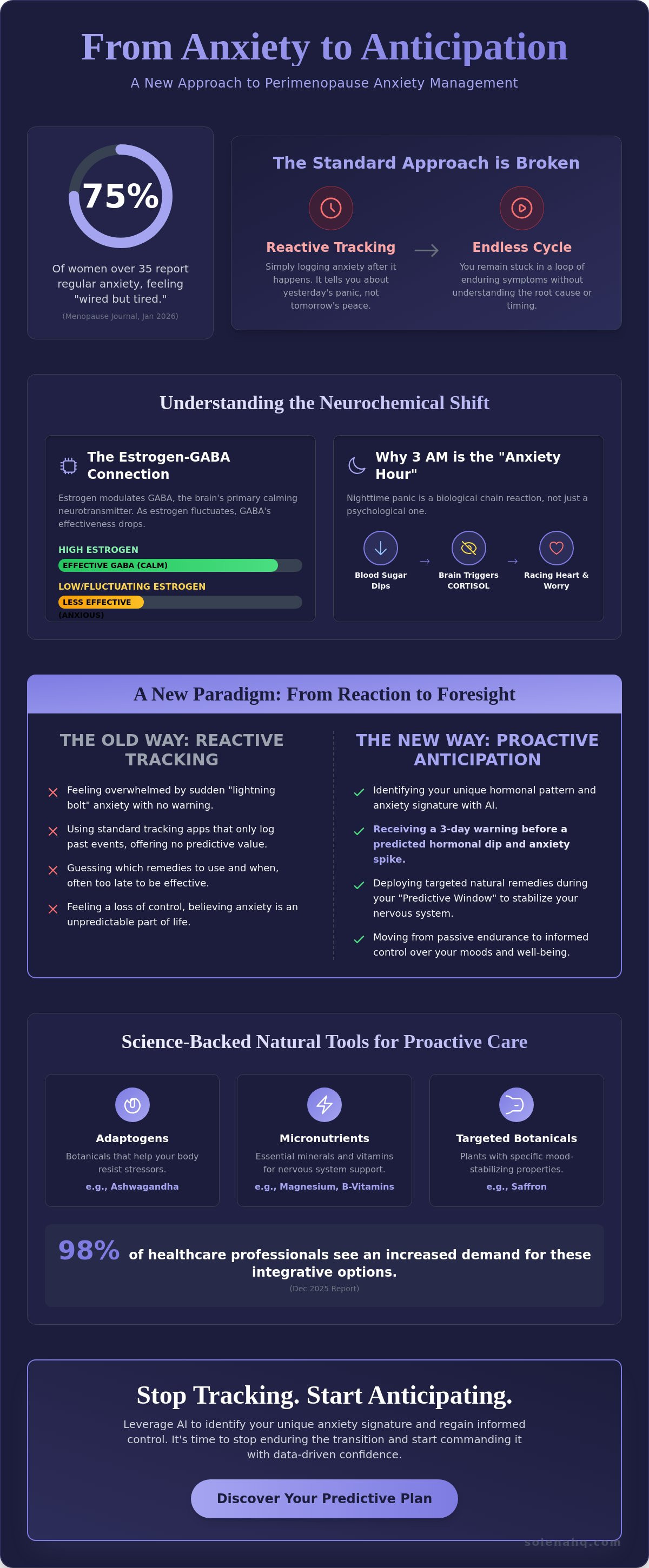
A January 2026 study in the journal Menopause found that 75% of women over age 35 report regular anxiety. Most spend their days bracing for the next sudden panic attack or 3 AM worry cycle. You might feel "wired but tired" and fear you're losing your mind. It's a common experience, but the standard approach is broken. Traditional tracking only tells you what happened yesterday. To find lasting relief, you need to move from reactive logging to proactive anticipation. Using targeted natural remedies for perimenopause anxiety allows you to intervene before the hormonal spike occurs.
This guide reveals how to time your wellness rituals to your unique biological rhythm. Even with the February 2026 FDA updates regarding hormone therapy safety, a December 2025 report showed that 98% of healthcare professionals see an increased demand for integrative options. Women want tools that explain the "why" behind the worry. We'll explore how science-backed botanicals like saffron and ashwagandha work best when they're part of a predictive plan. You'll learn to de-escalate panic and achieve predictable mood stability. Tracking is history. Anticipation is the future. It's time to stop enduring the transition and start commanding it with data-driven confidence.
Key Takeaways
- Identify the neurochemical shift behind the "lightning bolt" of worry. Understand how progesterone withdrawal impacts your central nervous system.
- Discover 12 science-backed natural remedies for perimenopause anxiety. Learn to categorize tools like adaptogens and micronutrients for your specific needs.
- Shift from reactive tracking to proactive foresight. Use a 3-day warning system to adjust your wellness routine before hormonal volatility peaks.
- Build a personalized wellness plan that evolves with you. Leverage AI to identify your unique anxiety signature and regain informed control over your moods.
Understanding the Perimenopausal Anxiety Spike
Perimenopause anxiety isn't a character flaw. It isn't a simple reaction to a busy life. It's a physiological response to erratic hormonal withdrawal. Unlike generalized anxiety, this often feels like a "lightning bolt." It strikes without warning; it hits even when your life is perfectly calm. You aren't just stressed. Your brain is reacting to a shifting internal environment that standard tracking apps usually fail to capture. They record the past. They tell you that you felt anxious yesterday. They don't explain the "why" behind the worry or help you prepare for the next wave. This gap is where most psychological symptoms during perimenopause become overwhelming.
True relief requires moving beyond reactive habits. You need to identify your "Predictive Window." This is the specific 72-hour period before a hormonal dip where you can deploy natural remedies for perimenopause anxiety to stabilize your nervous system. By anticipating the shift, you move from passive endurance to informed control. You stop wondering when the panic will hit and start preparing your body to meet it with resilience.
To better understand how these hormonal shifts impact your mental clarity, watch this breakdown of management strategies:
The Estrogen-GABA Connection
Estrogen does more than manage your cycle; it's a powerful modulator of brain chemistry. As levels fluctuate, your GABA receptors become less sensitive. GABA is the brain’s primary inhibitory neurotransmitter responsible for calm. When estrogen drops, GABA can't do its job effectively. You end up feeling "wired but tired." Your body is exhausted, but your brain is stuck in high gear. Research from late 2025 highlights that this receptor desensitization is a primary driver of the sudden irritability and "brain fog" many women experience. Without the calming influence of GABA, your central nervous system stays on high alert, making you feel perpetually on edge.
Why 3 AM is the "Anxiety Hour"
Nighttime panic isn't a coincidence. It's a biological chain reaction. During perimenopause, your body becomes less efficient at regulating blood sugar. When glucose levels dip at night, your brain triggers a cortisol spike to bring them back up. Cortisol is the "fight or flight" hormone. It wakes you up with a racing heart and a sense of impending doom. This volatility mimics a panic attack during what should be deep sleep. It's a physical alarm clock you didn't set. If you're wondering if these midnight cycles are part of the transition, check our Am I in Perimenopause? The Proactive Symptom Checklist for 2026. Understanding these mechanics is the first step toward effective anticipation. You aren't losing your mind; you're just experiencing a neurochemical surge that you can learn to predict.
The Biology of the "Hidden" Anxiety Wave
State anxiety is a reaction. Hormonal anxiety is a condition. One is about what is happening to you; the other is about what is happening within you. Understanding this distinction changes everything. It's the difference between feeling guilty for your stress and recognizing a biological event. This shift is driven by your allostatic load. Perimenopause increases the cumulative wear and tear on your nervous system. It lowers your threshold for resilience. Things that were manageable five years ago now feel like emergencies. You aren't less capable. Your biological buffer is simply thinner.
Technology bridges the gap between feeling and knowing. While you might feel a random wave of dread, AI looks deeper. It identifies patterns in these waves that the human eye misses. By analyzing data like resting heart rate and sleep cycles, it can predict an upcoming spike. This foresight allows you to deploy natural remedies for perimenopause anxiety before the wave crashes. You aren't just surviving the storm. You're anticipating it. To start seeing these patterns for yourself, you can explore how Solena maps your unique hormonal signature with precision.
Progesterone: Your Internal Off-Switch
Think of progesterone as your body's natural Valium. It's a neurosteroid that calms the central nervous system. In your 40s, the luteal phase of your cycle becomes an anxiety minefield. This is because perimenopause often involves skipped ovulations. If you don't ovulate, your body doesn't produce that essential progesterone surge. The result is a chemical imbalance that leaves you feeling vulnerable. Specifically, there is a 3-day window before menstruation where anxiety typically peaks. During this time, the mental health aspects of menopause become most pronounced. You aren't imagining the tension; you're experiencing a neurochemical deficit.
The Cortisol Cross-Talk
When your ovaries begin to slow down, your adrenal glands try to pick up the slack. They attempt to compensate for the decline in sex hormones. They often fail. This creates cortisol cross-talk, where your stress hormones stay permanently elevated. This is why traditional stress management feels impossible during a hormonal spike. You can't simply breathe through a chemical surge that your body is actively manufacturing. It's also why the myth of adrenal fatigue is so persistent; your body is simply exhausted from the constant effort of trying to maintain balance. Effective natural remedies for perimenopause anxiety must account for this adrenal strain. You need tools that support your internal rhythm rather than just masking the symptoms of a spike.
12 Natural Remedies for Perimenopause Anxiety
Remedies aren't magic bullets. They are tools in a larger Personalized Wellness Plan, like the ones generated through the Solena App. What works for your neighbor might not work for you. This is the reality of bio-individuality. To find the right natural remedies for perimenopause anxiety, you must match the intervention to your specific hormonal state. We categorize these into three distinct pillars: micronutrients, adaptogens, and physiological interventions. By timing these to your unique cycle, you stop reacting to symptoms and start anticipating them.
The "Big Three" Supplements for Hormonal Calm
Micronutrients and botanicals provide the chemical foundation for a stable nervous system. They work best when they target the receptors desensitized by estrogen loss.
- Magnesium Glycinate: Don't settle for citrate or oxide. The glycinate form is bound to glycine, an amino acid that promotes relaxation. It crosses the blood-brain barrier efficiently to soothe the nervous system and improve sleep quality.
- L-Theanine: This is the non-drowsy "calm" found in green tea. It increases alpha brain waves, which are associated with "relaxed alertness." It's perfect for when you feel wired but need to remain functional.
- Ashwagandha: This adaptogen works by lowering the cortisol ceiling. A December 2025 clinical review confirmed that consistent use reduces serum cortisol levels by up to 27% in perimenopausal women.
Nervous System "Off-Switches"
Sometimes you need immediate relief. You can't wait for a supplement to digest. Physiological hacks bypass the amygdala and force the body into a parasympathetic state. These are your "break glass in case of emergency" tools.
Vagus nerve stimulation is a powerful gap-closer. Splash your face with cold water or hum a low tone for 60 seconds. These actions stimulate the vagus nerve, sending an immediate "safety" signal to the brain. For a mental reset, use Box Breathing. Inhale for four, hold for four, exhale for four, and hold for four. This is a tactical tool used to de-escalate panic in seconds. If you're awake at 3 AM, use the 4-7-8 technique. Inhale for four, hold for seven, and exhale for eight. The long exhale is the "off-switch" for your fight-or-flight response.
Dietary Stabilizers
Your diet either fuels or fights your anxiety. Blood sugar management is the most overlooked factor in mood stability. Glucose spikes trigger insulin surges, which later lead to crashes that mimic perimenopausal panic. Keep your levels steady with protein and fiber at every meal. Additionally, incorporate phytoestrogens like flaxseed and fermented soy. These plant compounds bind to estrogen receptors, smoothing out the erratic curve of the transition. For a deeper look at how to time these dietary shifts, leveraging insights from personal tracking data can be highly beneficial. Managing your internal environment is the first step toward reclaiming your peace.
Beyond Survival: Building a Proactive Anxiety Protocol
Survival is exhausting. Strategy is empowering. Most women treat anxiety as an uninvited guest they must endure. The Solena Method shifts this narrative. We treat anxiety as a predictable biological event rather than a random emotional crisis. By identifying the wave before it peaks, you can deploy your protocol with precision. You don't just react to the panic. You prepare the body to neutralize it. This shift requires a 3-day warning system that allows you to adjust your environment and internal chemistry ahead of time.
Effective management relies on "pre-loading" your system. If you wait until you're in the middle of a panic attack to use natural remedies for perimenopause anxiety, you're already behind the curve. True relief comes from intervention during the high-volatility windows identified by your data. This foresight allows you to reclaim informed control over your schedule and your moods. To see how this foresight changes your daily life, you can start your personalized wellness plan today.
Step 1: Identify Your Volatility Baseline
Your body sends signals long before your mind feels the dread. The key is monitoring your Heart Rate Variability (HRV). This metric tracks the variation in time between each heartbeat; it's the ultimate anxiety early-warning system. Look for the "3-day dip" in your metrics. A drop in HRV often precedes felt anxiety by 24-48 hours. When you see this downward trend, your predictive window has opened. You now have a clear head start to implement calming strategies before the neurochemical shift takes hold.
Step 2: The "High-Alert" Routine
Once your data sounds the alert, your routine must pivot. This is the time to adjust exercise intensity and dietary triggers. High-intensity interval training (HIIT) can spike cortisol when your body is already vulnerable. During high-anxiety windows, prioritize yoga or steady-state walking over HIIT. Increase your magnesium glycinate dosage and remove all caffeine 72 hours before a predicted spike. This isn't about doing less. It's about doing what is right for your current neurochemistry. Utilizing proactive natural remedies for perimenopause anxiety ensures you stay one step ahead of the wave.
Communication is the final piece of a proactive protocol. Share your predictive plan with partners and family. It removes the mystery and the guilt. Instead of saying "I'm just stressed," try "My data shows a hormonal dip, so I'm focusing on my high-alert calm routine for the next three days." This clarity transforms a personal struggle into a shared, manageable plan. Choosing the right tools makes this transition seamless. Tracking apps tell you where you've been, but an anticipation-focused tool tells you where you're going. For a deeper dive into this distinction, read Choosing the Best Perimenopause App: Why Anticipation Beats Tracking.
Anticipating Peace: The Solena Approach to Mental Wellness
The unknown is the greatest fuel for anxiety. Solena acts as your Visionary Guardian, removing the mystery of hormonal shifts by replacing it with data-driven foresight. Most tools focus on the past. They ask what you felt. We focus on the future. We tell you what you will feel. By analyzing your daily health logs and physiological data, our AI identifies your unique "Anxiety Signature." This is a specific pattern of biometric changes that occurs before your mood shifts. You stop being a passenger in your own transition. You become the pilot.
Anticipation is the bridge between panic and peace. When you can see the wave coming, it loses its power to overwhelm you. Solena’s Advance Symptom Alerts provide a steady pulse of information that reduces your mental load. By delivering these alerts 48 to 72 hours in advance, Solena ensures you have the right natural remedies for perimenopause anxiety ready at the exact moment they are needed. This isn't just monitoring. It's conversational intelligence designed to keep you one step ahead of your hormones.
Your AI-Powered Wellness Plan
Solena suggests specific natural remedies for perimenopause anxiety based on your real-time sleep and hormone data. It isn't a guess. It's a personalized calculation. When the app detects a dip in your recovery metrics or a shift in your cycle volatility, it updates your wellness plan instantly. It might suggest increasing your magnesium intake or prioritizing a specific breathing technique for the upcoming night. This shift in perspective is life-changing. You move from asking "What is wrong with me?" to stating "I am prepared for this." Informed control is the strongest defense against the "wired but tired" cycle. Empower your transition with Solena’s predictive wellness plans.
The Future of Menopause Management
Data-driven confidence is the ultimate remedy for anxiety. There is profound reassurance in knowing a symptom is "hormonal" rather than "personal." It strips away the shame and the fear that you are losing your mind. You realize your brain is simply responding to a chemical withdrawal that can be managed. This clarity allows you to deploy your personalized wellness plan with efficiency and calm. We are moving toward a world where menopause is managed with technological precision rather than passive endurance. The transition is complex, but your response doesn't have to be. For more on this shift, read The Rise of the Predictive Women’s Health Platform: Beyond Basic Tracking. Stop tracking the struggle. Start anticipating the peace.
Command Your Hormonal Future
Anxiety doesn't have to be your default state. You've learned that the "lightning bolt" of dread is a biological response to neurochemical shifts, not a personal failure. By identifying the 3-day volatility window and the critical role of the progesterone "off-switch," you've already shifted the narrative. True relief comes from the strategic application of natural remedies for perimenopause anxiety. Whether it's the precision of magnesium glycinate or the tactical use of vagus nerve stimulation, you now have a toolkit built for resilience.
The transition from tracking to anticipation is where you regain informed control. A December 2025 report highlights that 98% of health experts now prioritize these proactive, integrative approaches. You don't need to wait for the next 3 AM wake-up call to take action. With AI-powered accuracy and personalized wellness alerts, you can stay one step ahead of every hormonal wave. It's time to stop enduring and start leading. Start anticipating your symptoms today with Solena. Your peace of mind is no longer a matter of chance; it's a matter of data-driven confidence.
Frequently Asked Questions
Is perimenopause anxiety different from regular anxiety?
Yes. Perimenopause anxiety is a neurochemical response to erratic hormonal withdrawal rather than a reaction to situational stress. While regular anxiety often has a clear trigger, this "lightning bolt" anxiety can strike during perfectly calm moments. A global study from January 2026 found that 75% of women over age 35 experience these sudden shifts due to dropping estrogen levels desensitizing the brain's calm-inducing receptors.
How can I stop a perimenopause panic attack naturally?
Use immediate physiological "off-switches" like the 4-7-8 breathing technique or cold water exposure to your face. These actions bypass the amygdala and stimulate the vagus nerve to force your body into a parasympathetic state. These are essential natural remedies for perimenopause anxiety because they work in seconds to de-escalate the fight-or-flight response that hormonal volatility triggers.
Does Magnesium really help with perimenopausal mood swings?
Magnesium Glycinate is highly effective because it is bound to glycine, which promotes relaxation and crosses the blood-brain barrier. It helps stabilize the nervous system by binding to GABA receptors that have been affected by estrogen loss. A December 2025 clinical review confirmed that consistent magnesium supplementation significantly reduces the "wired but tired" sensation and improves sleep quality for women in transition.
Can I use natural remedies alongside HRT for anxiety?
Yes. Many women adopt an integrative approach to manage their transition. A December 2025 report noted that 98% of healthcare professionals see an increase in patients requesting lifestyle-based interventions alongside traditional medicine. While HRT addresses systemic hormone levels, natural tools like adaptogens and micronutrients provide targeted support for the nervous system's daily resilience.
How long does perimenopause anxiety usually last?
The perimenopause transition typically lasts between four and ten years. Anxiety symptoms often peak during the late perimenopause stage when hormonal fluctuations are most erratic. Identifying your unique "Anxiety Signature" through data allows you to manage these windows effectively. You don't have to endure a decade of worry when you can anticipate and neutralize the spikes.
What is the best time of day to take supplements for menopause anxiety?
Timing should be based on your specific symptom patterns identified in your daily health logs. Generally, take Magnesium Glycinate in the evening to support deep sleep and prevent 3 AM wake-ups. Adaptogens like Ashwagandha are often most effective when taken in the morning to help lower your cortisol ceiling throughout the day. Your personalized wellness plan will help you find the optimal window for your biology.
Can an app really predict when I will feel anxious?
Yes. AI can identify physiological markers, such as a drop in Heart Rate Variability (HRV), that often precede felt anxiety by 24 to 48 hours. Solena’s AI looks for these patterns to provide Advance Symptom Alerts. This technology moves you from reactive tracking to proactive anticipation. It gives you a clear head start to implement natural remedies for perimenopause anxiety before the neurochemical shift occurs.
Why do I feel more anxious at night during perimenopause?
Nighttime anxiety is usually a biological chain reaction involving blood sugar and cortisol. When your glucose levels dip at night, your body triggers a cortisol spike to stabilize them, which wakes you up in a state of panic. This often happens around 3 AM. It is a physical fight-or-flight response to hormonal volatility rather than a reflection of your mental state.
Disclaimer
Solena is designed to support awareness, not replace care. It does not provide medical advice, diagnosis, or treatment. Always consult a qualified healthcare professional for medical guidance.