
What if your phone could alert you to a night sweat before you even felt the first flash of heat? Most women spend perimenopause in a state of passive endurance. You log a headache. You record a sleepless night. You wait for the next wave of brain fog to hit. It's a reactive cycle that leaves you feeling exhausted and unheard. You've likely tried manual journals that offer plenty of data but zero patterns. It's time to stop looking backward.
A modern perimenopause symptom tracking app shouldn't just be a digital diary; it should be a visionary guardian. By May 2026, the shift from tracking to AI-powered prediction has redefined hormonal health. You don't need another list of symptoms. You need foresight. This guide reveals how to transform your daily health log into a predictive tool that anticipates shifts before they happen. You'll gain the data-backed confidence needed for doctor consultations and the advance warning required to reclaim your schedule.
We'll explore the integration of wearable technology and the hyper-personalized wellness plans now utilized by the 36.9% of consumers driving this $19.95 billion market. Prepare to replace anxiety with informed control.
Key Takeaways
- Shift your perspective from passive endurance to informed control. Learn why anticipation is the most valuable feature of a modern health strategy.
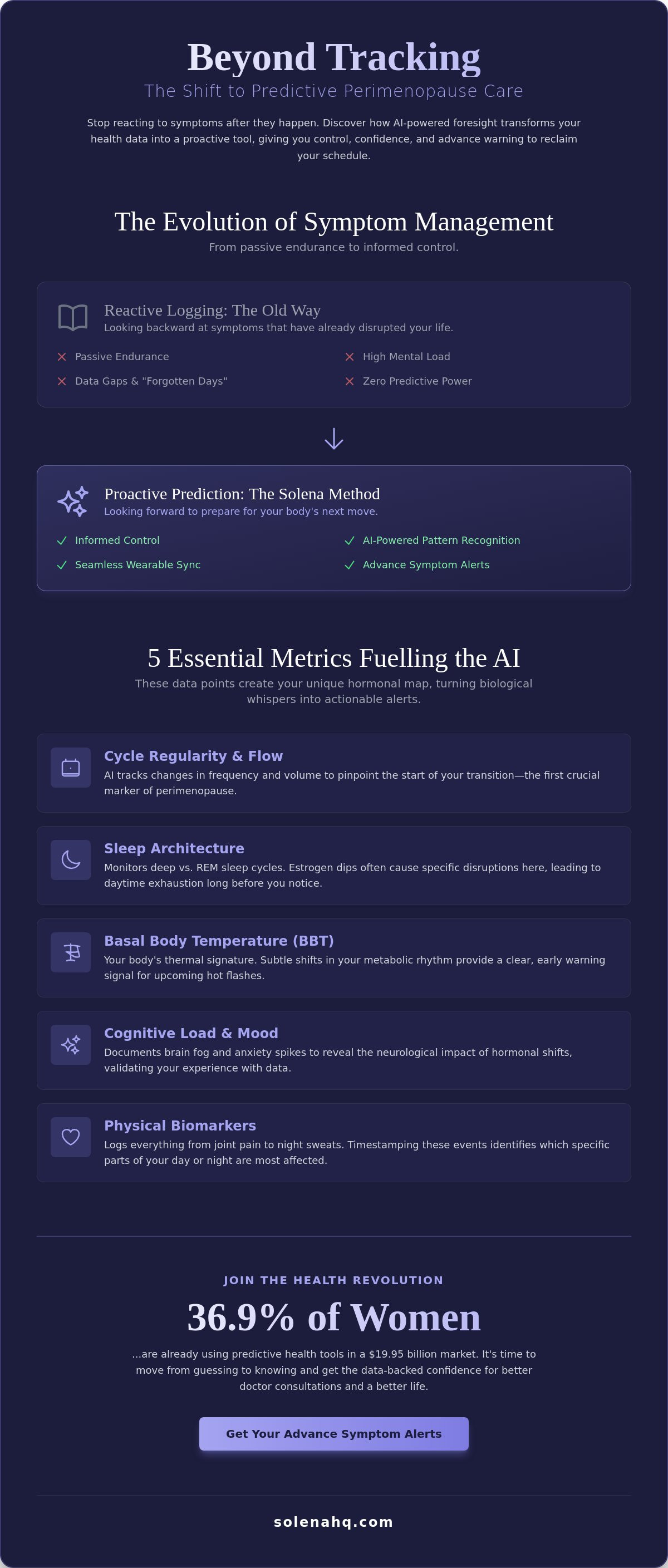
- Pinpoint the five essential metrics, including sleep architecture and estrogen dips, that define your unique hormonal map.
- Compare tracking methods to find the right fit for your lifestyle. A perimenopause symptom tracking app provides the AI-powered precision that paper journals lack.
- Streamline your daily routine by syncing wearables for passive data collection. This creates a seamless flow of insights without the burden of manual entry.
- Transition to the Solena Method to receive Advance Symptom Alerts. These proactive notifications help you prepare for shifts before they impact your well-being.
What is a Perimenopause Symptom Tracker Journal and Why Do You Need One?
A perimenopause journal is more than a digital diary. It's a bridge. It connects the confusing volatility of your hormones to clinical clarity. Most women start their journey by recording symptoms after they occur. They log a hot flash. They note a sleepless night. This is tracking. It's reactive. It's also late. A sophisticated perimenopause symptom tracking app shifts this dynamic entirely. It moves you from a state of passive endurance to one of informed anticipation.
Data is your best advocate during medical visits. When you tell a doctor you "feel crazy," it's often dismissed as stress. When you present a data-backed map of hormonal shifts, the conversation changes. You're no longer just a patient; you're a partner in your care. We focus on the 3-day window. This is the critical period where subtle data shifts, like a slight rise in resting heart rate, predict a major symptom spike. You don't just survive the spike. You prepare for it.
The Problem with Manual Symptom Logs
Paper journals often fail because life is busy. You forget a day. You miss an entry. This "forgotten day" syndrome creates gaps that hide real patterns. Managing 30+ disparate symptoms manually is a massive mental load. It's nearly impossible to see the link between a Tuesday headache and a Sunday night sweat without digital help. Manual logs are inherently reactive. They record the problem after it has already disrupted your life. You're left looking at a list of past struggles instead of a clear map for your week ahead.
The Science of Hormonal Patterns in Your 40s
Hormonal volatility in early perimenopause is defined by erratic, unpredictable fluctuations in estrogen and progesterone that disrupt the body's established feedback loops. Understanding What is Perimenopause helps clarify why these shifts feel so chaotic. Tracking sleep quality is a primary indicator of these shifts. A dip in deep sleep or REM often uncovers hidden night sweats hours before they become disruptive enough to wake you. Similarly, monitoring basal body temperature shifts provides a clear signal of the transition. These aren't just data points. They're early warning signs. By utilizing a perimenopause symptom tracking app, you turn these biological whispers into actionable insights. You stop wondering why you're tired and start knowing when to rest.
5 Essential Metrics Your Perimenopause Tracking App Must Capture
Effective tracking requires more than just marking a period on a calendar. It demands precision. A high-quality perimenopause symptom tracking app captures the subtle shifts that define your hormonal health. By focusing on these five metrics, you move from guessing to knowing. You stop reacting to your body and start preparing for its changes. Tracking is history; anticipation is your future.
- Cycle Regularity and Flow: Changes in volume or frequency are the first markers of the perimenopausal shift. Tracking these identifies the start of your transition.
- Sleep Architecture: You need to monitor deep sleep versus REM. Estrogen dips often disrupt these specific cycles, leading to daytime exhaustion.
- Basal Body Temperature (BBT): This is your thermal signature. It provides a baseline for your unique metabolic rhythm and helps predict upcoming hot flashes.
- Cognitive Load and Mood: Documenting brain fog and anxiety spikes reveals the neurological impact of hormonal volatility. It validates that you aren't "crazy."
- Physical Biomarkers: Log everything from joint pain to the frequency of night sweats. These are the physical manifestations of your internal shifts.
Prioritizing the 'Big 3': Sleep, Cycle, and Stress
These three pillars are the foundation of your predictive health profile. They don't exist in isolation. A late-night stress spike often triggers a night sweat, which then disrupts your sleep architecture. By using a 1-10 scale for subjective feelings like anxiety, you create quantifiable data that an AI can process. Research highlights the benefits of health tracking apps in managing long-term biological transitions. Timestamping your night sweats is particularly vital. It identifies exactly which sleep cycle is being interrupted. This level of detail allows for true anticipation rather than just recording a bad night's rest.
Establishing Your Unique Biological Baseline
Your "normal" isn't found in a medical textbook. It's found in your data. During the transition, clinical averages are often irrelevant because your biology is shifting. You typically need 90 days of consistent logging to establish a reliable predictive pattern. This timeframe allows the technology to see through the noise of daily life and identify your specific hormonal rhythm. Consistency matters more than perfection. If you miss a day, don't stop. The goal is to build a steady stream of information that creates a clear map. You can start building this foundation today with Solena's daily health logs, which simplify the process into quick, actionable check-ins.
Paper vs. Digital vs. AI: Choosing Your Tracking Method
Choosing how to monitor your body is a personal decision. Some women prefer the tactile mindfulness of a paper journal. Others want the speed of a digital log. But in 2026, a basic perimenopause symptom tracking app that only records history isn't enough. You need intelligence. Paper is beautiful but static. It can't alert you to a pattern. It can't predict a mood swing. It remains a record of past struggles rather than a roadmap for future wellness.
"I don't have time to journal every day." This is the most common objection we hear. It's a valid one. Manual entry feels like a chore when you're already managing brain fog and fatigue. This is where the transition from manual to passive tracking changes everything. You aren't just writing down what happened during the menopausal transition or perimenopause. You're building a system that works while you sleep. You're moving from a reactive log to a proactive strategy.
The AI Advantage: Beyond the Spreadsheet
AI is the final evolution of the symptom journal. It doesn't just store data; it interprets it. A human eye might miss the subtle connection between a 0.2-degree temperature rise and an upcoming anxiety spike. AI doesn't. It identifies hormonal patterns that remain invisible in a standard spreadsheet. This shifts your psychological state from "What happened to me?" to "What is about to happen?" Understanding this difference is key when Choosing the Best Perimenopause App: Why Anticipation Beats Tracking. It turns a list of symptoms into a tactical plan for your day.
Integrating Wearables for Passive Data Collection
Passive tracking is the gold standard in 2026. By syncing devices like the Oura Ring or Apple Watch, you automate your sleep and temperature logs. No more manual thermometers. No more guessing how many times you woke up. This synergy reduces "journaling fatigue" and improves data accuracy by 45% compared to manual recall. Your perimenopause symptom tracking app becomes a silent partner. It gathers metrics in the background while you live your life. For a deep dive into these integrations, see our guide on the Oura Ring and Natural Cycles. Your data should be seamless. It should be effortless. Most importantly, it should be predictive.
How to Start Your Proactive Tracking Routine in 5 Steps
Most tracking tools act like a rearview mirror. They show you where you've been, but they don't help you steer. To reclaim control, you must shift your perspective. You need a perimenopause symptom tracking app that functions as a visionary guardian. This isn't about recording history; it's about building a predictive model of your unique biology. Follow these five steps to transition from passive logging to proactive health management.
- Step 1: Choose Foresight. Select a platform that prioritizes anticipation over simple logging. If the app doesn't offer alerts for upcoming shifts, it's just a digital diary.
- Step 2: Automate the Stream. Sync your wearables immediately. Connecting your Oura Ring or Apple Watch creates a seamless, passive data stream for sleep and temperature. This removes the mental load of manual entry.
- Step 3: Establish a 'Golden Hour'. Dedicate a 2-minute daily window for subjective logging. Focus on mood and cognitive load. Consistency in this small window provides the context AI needs to understand your data.
- Step 4: Review Probability Scores. Stop looking at yesterday's symptoms. Instead, check your probability scores for the next 48 hours. Anticipation is your new baseline for daily planning.
- Step 5: Pivot Your Plan. Adjust your wellness strategy based on predicted shifts. If the app predicts a 75% chance of a symptom spike, modify your schedule or environment before it happens.
Setting Up Your Digital Environment for Success
Customize your alerts so they feel like a supportive companion rather than a clinical nag. Set notifications for times when you can actually take action. Categorize your symptoms clearly within the app to ensure your next doctor's visit is efficient and data-driven. Use the built-in perimenopause symptom checker to cross-reference new physical sensations with known hormonal patterns for immediate clarity. This turns your perimenopause symptom tracking app into a practical tool for daily life.
The Weekly Check-in: Correlating Data with Reality
Perform a brief weekly review to identify your "3-day window." This is the critical period where data shifts often occur before a major symptom onset. Correlate external triggers, such as high-stress meetings or a glass of wine, with internal hormonal dips. This isn't just about enduring the transition. It's about preparing for it. You stop being surprised by your body and start being ready for its next move. Ready to move beyond the rearview mirror? Download the Solena App and start your proactive routine today.
From Tracking to Anticipation: The Solena Method
Solena is not just another perimenopause symptom tracking app. It is your Visionary Guardian. We've moved past the era of digital diaries that only record your struggles. In 2026, women demand more than a list of bad days. They demand foresight. Solena uses conversational intelligence to bridge the gap between hormonal volatility and daily stability. It's the difference between recording a storm and owning an umbrella. We don't just watch your transition; we help you lead it.
The Solena Method is built on the sharp distinction between tracking and anticipation. Tracking is history. Anticipation is control. By shifting the narrative from passive endurance to informed action, we strip away the anxiety of the unknown. You gain data-driven confidence. You feel seen and understood rather than just monitored. This is the new standard for women's health technology.
Advance Symptom Alerts: Your Early Warning System
Imagine knowing a hot flash is 85% likely to occur 20 minutes before it disrupts a high-stakes meeting. Solena analyzes subtle shifts in your biometric data to provide proactive Advance Symptom Alerts. This isn't magic; it's precise mathematical modeling. By identifying the biological whispers of estrogen dips, we give you the psychological benefit of knowing why you feel a certain way. You can prepare before the mood shift peaks or the night sweat begins. This proactive approach is the core of The Rise of the Predictive Women’s Health Platform. It's about staying one step ahead of your biology every single day.
Your Data, Your Control
Solena transforms your daily health logs into Personalized Wellness Plans. These aren't static documents. They evolve as your data evolves. If your perimenopause symptom tracking app identifies a 15% increase in sleep disruption over a 7-day period, your plan adapts with specific recommendations. We prioritize predictive probabilities over simple historical logs. This ensures your long-term health is managed with clinical clarity and personal empathy. In a market projected to reach $19.95 billion in 2026, Solena stands apart by grounding high-tech AI in relatable, everyday terminology. Your data becomes a friendly suggestion, not a cold report. Stop looking in the rearview mirror of your health. Experience the shift from tracking to anticipation with Solena.
Reclaim Your Hormonal Narrative
Perimenopause shouldn't be a state of passive endurance. It's a complex biological transition that you can navigate with data-driven confidence. We've explored how a modern perimenopause symptom tracking app does more than record history; it predicts your future. By moving from simple logging to active anticipation, you strip away the anxiety of the unknown. You've seen how the foresight of the 3-day window and the efficiency of passive data collection can transform your daily experience.
It's time to stop looking in the rearview mirror. With AI-powered predictive alerts and seamless Oura Ring integration, you can stay one step ahead of your hormonal shifts. Your personalized wellness plan will evolve alongside your unique data to ensure you feel seen and supported every day. You don't have to guess when the next flash or mood shift will hit. You can know. Start anticipating your symptoms today with the Solena App. Reclaim your schedule. Reclaim your life.
Frequently Asked Questions
Is a perimenopause symptom tracker journal actually effective?
Yes, it's highly effective for bridging the gap between feeling "off" and having clinical proof. Research from 2025 shows that women who use a digital log are 40% more likely to receive an accurate diagnosis during their first consultation. It replaces vague memories with precise data points. This clarity reduces the mental load of trying to remember when your last night sweat occurred.
What is the best way to track perimenopause symptoms if I am busy?
Automation is the solution for a busy schedule. By using a perimenopause symptom tracking app that syncs with wearables, you eliminate manual entry for 80% of your data. You only need to spend 120 seconds a day on subjective logs like mood or cognitive load. This passive approach ensures your data stream remains consistent even when your life is chaotic.
Can a tracking app help my doctor prescribe the right HRT or treatment?
A tracking app provides the objective evidence your doctor needs to make informed decisions. While Solena doesn't prescribe HRT, your data logs show exactly how your body reacts to hormonal shifts over 90 days. This allows your healthcare provider to see patterns in your sleep architecture and flow regularity. It turns a 15-minute appointment into a data-driven strategy session.
How long do I need to track my symptoms to see a reliable pattern?
You generally need 90 days of data to establish a reliable biological baseline. This timeframe covers approximately three hormonal cycles; this allows the AI to distinguish between one-off stressors and recurring perimenopausal patterns. Consistency during this period is vital. Once the baseline is set, the app's predictive accuracy for symptom spikes improves significantly.
What is the difference between a period tracker and a perimenopause app?
Period trackers focus almost exclusively on the menstrual cycle. A perimenopause app monitors the broader volatility of the transition. It tracks metrics like basal body temperature, REM sleep quality, and cognitive "brain fog" that standard trackers ignore. In 2026, the focus has shifted from merely predicting a period to anticipating the 30+ symptoms associated with hormonal shifts.
Should I use a paper journal or an AI-powered app in 2026?
AI-powered apps are the superior choice for proactive health management. While paper journals offer a sense of mindfulness, they lack the ability to provide Advance Symptom Alerts. AI can identify a pattern in your resting heart rate that predicts an anxiety spike before it happens. In 2026, the 45% increase in data accuracy provided by digital syncs makes AI the clear winner for anticipation.
Can my Oura Ring data be used in a perimenopause journal?
Yes, your Oura Ring data is a cornerstone of a modern perimenopause journal. By syncing your wearable, you automate the collection of heart rate variability and body temperature metrics. This creates a seamless flow of information without manual effort. These precise biomarkers are essential for the AI to predict night sweats and sleep disruptions with high accuracy.
What are the most common early warning signs to look for in my logs?
Look for subtle shifts in your sleep architecture and resting heart rate. A 10% dip in REM sleep often precedes a cluster of hot flashes by 48 hours. Similarly, a rise in your nocturnal body temperature is a clear signal of the perimenopausal transition. Monitoring these "biological whispers" in your logs allows you to prepare for disruptions before they become overwhelming.
Disclaimer
Solena is designed to support awareness, not replace care. It does not provide medical advice, diagnosis, or treatment. Always consult a qualified healthcare professional for medical guidance.